Customer acquisition cost is arguably the most important financial metric in any growth business. Get it right, and it guides smart investment decisions. Get it wrong — or worse, ignore it — and you can spend yourself into insolvency while celebrating record customer growth.
The dangerous part is that most companies calculate CAC incorrectly. They undercount costs, they average across segments that should be separated, and they never compare it against the metric that determines whether acquisition spending makes sense: customer lifetime value.
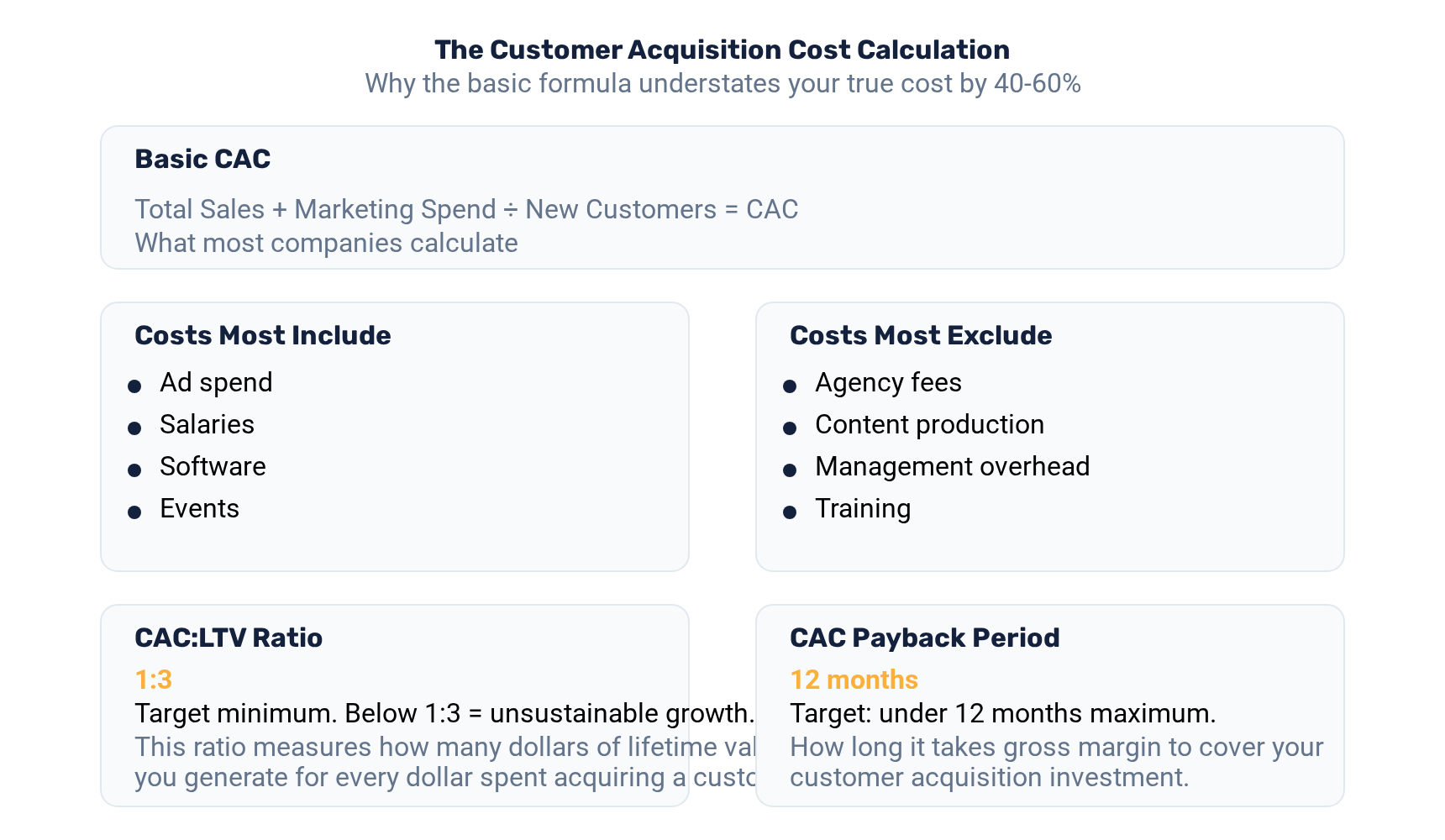
The Basic CAC Formula and Why It Is Incomplete
The standard CAC formula is simple:
CAC = Total Sales and Marketing Spend / Number of New Customers Acquired
If you spent $500,000 on sales and marketing last quarter and acquired 100 new customers, your CAC is $5,000.
This formula is directionally correct and practically insufficient. It understates the true cost by excluding expenses that directly contribute to acquiring customers.
The Fully Loaded CAC Calculation
A fully loaded CAC includes every cost associated with acquiring a new customer, not just the obvious line items.
Costs Most Companies Include
- Advertising spend: Paid search, paid social, display, sponsorships
- Marketing team salaries: Demand gen, content, marketing operations
- Sales team salaries and commissions: AEs, SDRs/BDRs, sales management
- Marketing software: HubSpot, ad platforms, SEO tools, content tools
Costs Most Companies Exclude (But Should Not)
- Sales enablement and training costs: Onboarding new reps, ongoing training programs, sales enablement tools — these directly improve acquisition effectiveness
- Technology overhead: The portion of CRM, analytics, and operations tools that support the acquisition function
- Agency and contractor fees: SEO agencies, PPC management, freelance content creators, design contractors
- Event and trade show costs: Booth fees, travel, materials, staff time
- Content production costs: Video production, design, copywriting for acquisition-focused content
- Customer success costs for onboarding: The portion of CS effort spent bringing new customers to their first value milestone — this is an acquisition cost because it is required to convert a sale into a realized customer
- Overhead allocation: Office space, HR, finance, and administrative costs attributable to the sales and marketing functions
- Data quality and operations: One of the most overlooked cost drivers is poor sales data quality, which inflates acquisition costs in ways that never appear on a line item.
When you add these excluded costs back in, most companies discover that their true CAC is 30-50% higher than their reported number. A $5,000 reported CAC is often a $7,500 fully loaded CAC.
CAC by Segment: The Critical Breakdown
Aggregate CAC hides dangerous variation across customer segments. You need segment-level visibility to make informed investment decisions.
By Channel
Calculate CAC for each acquisition channel separately: organic inbound, paid search, paid social, outbound sales, events, partnerships. The variation will be enormous. We routinely see 5-10x differences between the most efficient and least efficient channels. A wholesale distributor gained segment-level cost visibility after CRM transformation, discovering that their most profitable customer segment had a dramatically lower CAC than their high-volume segment, prompting a strategic shift in acquisition focus.
This analysis often reveals that a channel celebrated for high lead volume is actually the most expensive on a per-customer basis. Events, for example, generate high-quality conversations but at a CAC that can be 3-5x digital channels when you include all associated costs.
By Customer Segment
Calculate CAC separately for enterprise, mid-market, and SMB customers. Enterprise deals typically have higher CAC (longer sales cycles, more touchpoints, higher-seniority sales reps) but also higher lifetime value. SMB deals have lower CAC but potentially higher churn and lower expansion.
The danger is averaging these together. An overall CAC of $5,000 might mask an enterprise CAC of $25,000 and an SMB CAC of $500. The strategic implications of each are completely different.
By Product Line
If you sell multiple products, calculate CAC for each. A product that looks profitable in aggregate may be unprofitable when you isolate its acquisition costs. Conversely, a product with lower revenue may have such low CAC that its unit economics are your best in the portfolio.
The CAC-to-LTV Ratio: The Number That Matters Most
CAC in isolation is meaningless. A $10,000 CAC is excellent if the customer generates $100,000 in lifetime value and terrible if they generate $8,000.
The CAC-to-LTV ratio determines the sustainability of your growth.
LTV:CAC of 3:1 or higher: Healthy unit economics. You are earning $3 or more for every $1 spent on acquisition. There is room to invest more aggressively in growth.
LTV:CAC of 2:1 to 3:1: Marginal economics. Profitable but thin. Efficiency improvements or higher retention could push you into healthy territory.
LTV:CAC of 1:1 to 2:1: Unsustainable. You are spending nearly as much to acquire customers as they generate. Unless retention improves dramatically, you are running a break-even or money-losing acquisition engine.
LTV:CAC below 1:1: Crisis. You are paying more to acquire customers than they will ever generate in revenue. Every new customer you add makes the company less viable.
Calculating LTV Accurately
Customer Lifetime Value is calculated as:
LTV = Average Revenue Per Account x Gross Margin x Average Customer Lifespan
For a subscription business: if the average customer pays $2,000/month, your gross margin is 75%, and the average customer stays 36 months, LTV = $2,000 x 0.75 x 36 = $54,000.
Common LTV calculation mistakes include:
- Using revenue instead of gross margin. LTV should reflect profit, not revenue. If your gross margin is 60%, using revenue overstates LTV by 40%.
- Overestimating customer lifespan. Use actual observed retention data, not projections. If your company is three years old, you do not have enough data to claim a 10-year average lifespan.
- Excluding downgrades. If customers frequently downgrade plans, your average revenue per account is lower than the initial contract suggests. Use net revenue retention to adjust.
- Ignoring expansion revenue. Conversely, if customers frequently expand, your LTV is higher than initial contract value alone suggests.
CAC Payback Period: When You Break Even
CAC payback period measures how many months it takes for a new customer's gross margin to cover the cost of acquiring them.
CAC Payback = CAC / (Monthly Revenue Per Customer x Gross Margin)
If your CAC is $10,000, your average customer pays $1,000/month, and your gross margin is 75%, the payback period is $10,000 / ($1,000 x 0.75) = 13.3 months.
Benchmarks for B2B SaaS:
- Under 12 months: Excellent
- 12-18 months: Good
- 18-24 months: Acceptable for enterprise
- Over 24 months: Concerning — you need efficiency improvements or better retention
For non-SaaS businesses, adjust expectations based on your revenue model. A one-time purchase business needs to recover CAC from the first transaction. A recurring service business can amortize over the relationship.
Improving CAC Without Cutting Spend
Reducing CAC does not always mean spending less. Sometimes it means spending smarter.
Improve conversion rates. If you convert 2% of visitors to leads and 10% of leads to customers, improving either conversion point reduces CAC without touching the budget. A 1% improvement in lead-to-customer conversion can reduce CAC by 20-30%.
Shorten the sales cycle. Every day in the sales cycle costs money — rep time, management overhead, tool costs. If you can reduce your average cycle from 90 days to 60 days, you acquire the same customer at a lower cost.
Increase average deal size. If your CAC stays constant but your average deal size increases, the CAC-to-LTV ratio improves automatically. Invest in packaging, pricing, and upsell motions that increase initial contract value.
Focus on high-LTV segments. Rather than trying to reduce CAC across the board, shift acquisition investment toward the customer segments with the highest lifetime value. A higher CAC is acceptable when it comes with a proportionally higher LTV.
Invest in retention. Improving retention extends customer lifespan, which increases LTV, which improves the CAC-to-LTV ratio without changing acquisition spending at all.
Know your numbers. Calculate them correctly. Compare them across segments. And make every acquisition investment decision with full visibility into what you are actually spending and what you are actually earning. That is the calculation that determines whether your growth is sustainable or a slow-motion crisis.
Keep Reading
- PE Portfolio Case Studies — Case studies demonstrate CAC improvement from HubSpot.
- PE Portfolio Reporting for Operating Partners — CAC is a key metric in operating partner dashboards.
- Analytics & BI Services — CAC and LTV modeling is an explicit service offering.
How healthy is your portfolio company's CRM? Take the free assessment — 7 minutes, instant results.