Most PE-backed portfolio companies do not have a revenue operations function. They have a marketing person who also manages the CRM, or a sales operations analyst who runs reports, or nobody at all — the CRM is an orphaned system that everyone uses and nobody owns.
This is a structural problem, not a people problem. Revenue operations is a function that requires dedicated ownership — someone whose job is to ensure the systems, data, and processes that drive revenue are working correctly. Without that ownership, CRM quality degrades, reporting becomes unreliable, and the operating partner loses visibility into portfolio company performance.
This guide covers when to build a RevOps function, how to structure it, who to hire, and how to bridge the gap between "no RevOps" and "functioning RevOps team."
When a Portfolio Company Needs Dedicated RevOps
Not every portfolio company needs a full-time RevOps hire on day one. The trigger depends on company size, complexity, and the PE value creation plan.
Signals that a portco needs RevOps now:
- Revenue exceeds $10M annually
- Sales team is 10+ reps
- Marketing and sales use different systems or definitions
- Nobody owns the CRM — it is managed by committee or not at all
- Board reporting requires more than 2 hours to compile
- Forecast accuracy is consistently off by more than 25%
- The company is running on HubSpot (or any CRM) with adoption below 60%
Signals that the need is imminent (6-12 months):
- Revenue is growing past $5M with plans to scale
- The company is about to deploy or migrate a CRM platform
- A new sales process or go-to-market motion is being introduced
- The PE firm is standardizing operations across the portfolio
If three or more of these signals are present, the portfolio company needs RevOps capacity — whether that comes from a hire, a fractional resource, or an external partner.
The RevOps Org Structure
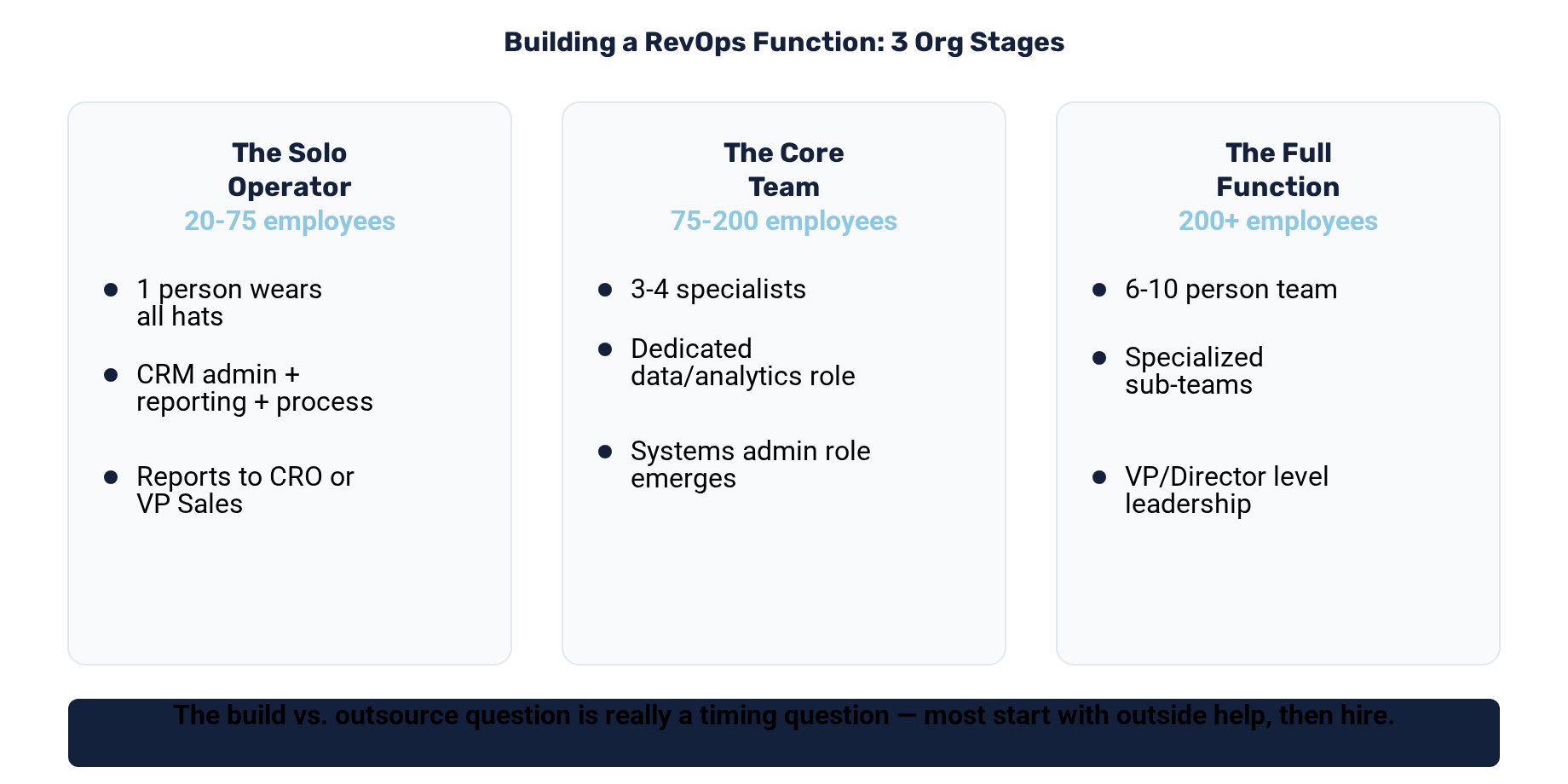
Revenue operations structure scales with company size. There is no point hiring a three-person RevOps team at a 30-person company. The structure should match the operational complexity.
Stage 1: The Solo Operator (Company size: 20-75 employees)
One person owns everything. This person is part systems administrator, part data analyst, part process designer. They report to the CRO, VP Sales, or COO — never to IT or marketing exclusively, because RevOps must serve the entire revenue engine.
Title: Revenue Operations Manager or Sales & Marketing Operations Manager
Responsibilities:
- CRM administration (user management, configuration, troubleshooting)
- Data quality management (deduplication, hygiene, governance)
- Reporting and dashboard creation
- Process documentation and enforcement
- Sales and marketing alignment (shared definitions, lead handoff, SLA management)
- Vendor management for revenue tools
- Training and onboarding new users
Profile to hire:
- 3-5 years of experience in sales operations, marketing operations, or CRM administration
- Hands-on HubSpot (or Salesforce) configuration experience — not just "used a CRM" but actually built workflows, reports, and integrations
- Comfortable with data: can write basic formulas, understands data structures, can troubleshoot reporting discrepancies
- Communication skills: this person must translate between sales, marketing, and leadership, each of which speaks a different language about revenue
- Systems thinking: the ability to see how a change in one part of the system affects downstream processes
Compensation range (2026): $85,000-120,000 base salary depending on market and experience. For PE-backed portcos in competitive markets, expect the upper range.
The critical mistake to avoid: Hiring a junior CRM admin and calling them "RevOps." CRM administration is a subset of revenue operations. A CRM admin maintains the system. A RevOps person designs and optimizes the revenue process, of which the CRM is one component. Hiring too junior for this role guarantees you will outgrow them within 12 months.
Stage 2: The Core Team (Company size: 75-200 employees)
Three roles with distinct focus areas. The solo operator cannot scale beyond 75-100 employees without sacrificing either system quality or strategic impact. A diagnostics company unified multiple disconnected systems under a centralized RevOps structure, and the transition required exactly this three-person team configuration to manage the complexity of system integration and data governance.
Role 1: RevOps Manager (Senior)
- Owns the overall RevOps strategy and roadmap
- Partners with CRO/VP Sales on process design and go-to-market execution
- Manages the RevOps team
- Owns board-ready reporting and investor-facing metrics
- Drives cross-functional alignment initiatives
Role 2: Systems Administrator
- Owns CRM configuration and day-to-day administration
- Manages integrations between CRM, marketing tools, and other systems
- Handles user management, permissions, and troubleshooting
- Maintains automation workflows and ensures they function correctly
- First point of contact for "the CRM is broken" requests
Role 3: Data and Analytics Specialist
- Owns data quality, governance, and reporting
- Builds and maintains dashboards and reports
- Conducts analysis to support revenue optimization decisions
- Manages data imports, exports, and enrichment
- Monitors data health metrics and resolves quality issues proactively
Compensation for the full team: $250,000-350,000 annually in total compensation.
Stage 3: The Full Function (Company size: 200+ employees)
At this scale, RevOps becomes a formal department with specialized sub-functions. The structure typically includes a Director or VP of Revenue Operations, a systems and tools team (2-3 people managing CRM, marketing automation, sales enablement tools, and integrations), a data and analytics team (2-3 people handling reporting, data science, and BI), and a process and enablement team (1-2 people owning sales process, training, and change management).
Most PE-backed portfolio companies will not reach Stage 3 during the hold period. The goal is typically to build Stage 1 in the first year, evolve to Stage 2 by year two, and hand off a functioning Stage 2 operation to the acquirer at exit.
The Build vs. Outsource Decision
For PE-backed portfolio companies, the build vs. outsource question is really a timing question: should we hire now and build internally, or should we use an external partner to establish the function and hire once the foundation is in place?
Arguments for hiring first:
- The person builds deep institutional knowledge
- Lower ongoing cost than a retained consulting engagement
- The person grows with the company
Arguments for outsourcing first, then hiring:
- An experienced external partner can build the foundation in 90-100 days — faster than recruiting, hiring, and onboarding a new employee
- The RevOps hire starts with clean systems, documented processes, and working reporting rather than inheriting chaos
- The external partner can help define the job description and interview candidates based on what the role actually requires (not what someone guesses it requires)
- If the hire does not work out, the external partner can backfill while you recruit again
Our recommendation: For portfolio companies at Level 1-2 on the RevOps Maturity Model — meaning the CRM is broken, data is messy, and adoption is low — outsource the foundation build first. Hiring a RevOps person into a broken environment guarantees frustration and likely turnover within 12 months.
Use an external partner (like our 100-Day Framework) to get the systems to a functioning state: clean data, configured CRM, basic automation, working reports, trained team. Then hire the RevOps person to maintain and optimize the foundation. This is the sequence that produces the best outcomes.
The First 90 Days for a New RevOps Hire
Whether you hire before or after establishing the foundation, the new RevOps person needs a structured onboarding plan. Without one, they will spend the first 90 days drowning in ad hoc requests and never establish strategic ownership.
Days 1-30: Audit and Understand
- Inventory all revenue tools and systems
- Assess data quality using the five-pillar framework
- Map current processes (lead flow, deal progression, handoff points)
- Interview stakeholders: what works, what is broken, what do they wish existed
- Document findings and prioritize issues
Days 31-60: Fix the Foundation
- Address the top 5 data quality issues identified in the audit
- Fix or rebuild the 3-5 most critical reports (pipeline, forecast, activity)
- Establish basic data governance rules (validation, required fields, naming conventions)
- Create or refine the key dashboards for sales management and executive visibility
Days 61-90: Optimize and Systematize
- Implement automation for recurring tasks (lead routing, data hygiene, reporting distribution)
- Build the reporting cadence (weekly, monthly, quarterly — who gets what and when)
- Establish the governance rhythm (monthly data quality reviews, quarterly system audits)
- Present the RevOps roadmap: here is where we are, here is where we need to be, here is the plan to get there
Day 90 success criteria:
- Stakeholders trust the pipeline report
- Weekly reporting is automated
- Data quality is measurably improving (tracked month over month)
- The RevOps roadmap is approved and resourced
Reporting Structure Matters
Where RevOps reports in the org chart has a direct impact on its effectiveness.
Report to the CRO or CEO: Best option. RevOps has the authority to enforce process compliance across sales and marketing, and has direct access to the executive who cares most about revenue performance.
Report to the VP Sales: Common but suboptimal. Sales operations is a subset of revenue operations. If RevOps reports to sales, marketing alignment becomes harder to achieve, and the function tends to become a sales support desk rather than a strategic function.
Report to the CMO: Less common but similarly suboptimal. The function tends to focus on marketing metrics and underserve sales operations.
Report to the CTO or IT: The worst option, and unfortunately common in companies that view CRM as "technology" rather than "revenue infrastructure." RevOps under IT becomes a help desk. Strategic process design does not happen. Adoption suffers because the function has no authority over the sales or marketing teams.
Our recommendation: RevOps reports to whoever owns the revenue number. In most PE-backed mid-market companies, that is the CEO or CRO.
Budget Expectations
For operating partners budgeting RevOps at a portfolio company:
| Item | Year 1 | Year 2 | Year 3 |
|---|---|---|---|
| RevOps hire(s) | $90,000-120,000 | $150,000-250,000 | $250,000-350,000 |
| CRM licensing | $40,000-80,000 | $40,000-80,000 | $50,000-100,000 |
| Additional tools | $10,000-30,000 | $15,000-40,000 | $20,000-50,000 |
| External support | $50,000-100,000 | $20,000-40,000 | $10,000-20,000 |
| Total | $190,000-330,000 | $225,000-410,000 | $330,000-520,000 |
Year 1 is the highest external support cost because it includes the initial implementation or rescue. By year 3, the function should be predominantly internal with minimal external support.
The ROI on this investment comes from pipeline visibility (catching revenue leaks), forecast accuracy (better resource allocation), operational efficiency (automation replacing manual work), and exit readiness (clean data and reliable reporting command premium valuations).
To assess whether your portfolio company is ready for a RevOps hire or needs foundation work first, start with our Portfolio Health Score.
Keep Reading
- The Complete HubSpot Guide for PE — Why internal RevOps capability is essential for sustained value.
- Revenue Operations Maturity Model — Benchmark where your portco's RevOps stands today.
- CRM Standardization Across PE Portfolio Companies — What RevOps teams execute and maintain.
- First 90 Days as a Revenue Operations Leader — The first 90 days from the RevOps leader's perspective.
- Marketing Operations Isn't IT — Why RevOps requires specialized roles.
How healthy is your portfolio company's CRM? Take the free assessment — 7 minutes, instant results.