If you manage operations across a private equity portfolio, you already know the problem. Company A runs Salesforce with half the fields populated. Company B just bought HubSpot but nobody configured it. Company C is still running deals through spreadsheets emailed between reps. You have no unified reporting, no reliable pipeline data, and every board meeting requires a week of manual data wrangling.
This is CRM chaos, and it is one of the most common — and most expensive — obstacles to value creation across PE portfolios.
The Real Cost of Fragmented CRM Systems
The financial damage from CRM fragmentation goes far beyond software licensing waste. When each portfolio company operates its own disconnected system, you lose the ability to benchmark performance, identify cross-portfolio trends, and make data-driven investment decisions.
Here is what fragmentation actually costs:
- Reporting overhead: Operations teams spend 15-25 hours per week manually aggregating data across portfolio companies for leadership reporting
- Delayed decision-making: Without real-time pipeline visibility, investment decisions lag by weeks or months
- Missed cross-sell opportunities: Portfolio companies that could refer business to each other never connect because the data lives in silos
- Due diligence friction: Every new acquisition requires a from-scratch technology assessment because there is no standard baseline
- Talent inefficiency: Each company hires its own CRM admin, creating redundant roles that a shared services model could eliminate
We have seen PE firms spend over $500,000 annually on CRM-related inefficiencies across a ten-company portfolio — and that figure does not include the revenue left on the table from poor pipeline management.
Why Portfolio Companies Resist Standardization
Before you can fix the problem, you need to understand why it persists. Portfolio company leadership teams resist CRM standardization for predictable reasons:
Autonomy concerns. CEOs and CROs worry that standardizing on a single platform means losing control over their sales processes. They have built their workflows around their current tools, and change feels like a threat to their operational independence.
Migration fear. The prospect of migrating years of customer data, deal history, and automation workflows from one system to another creates genuine anxiety. Teams have seen bad migrations destroy data integrity, and they do not want to be next.
Competing priorities. Portfolio companies are already under pressure to hit aggressive growth targets. Adding a technology migration to the roadmap feels like a distraction from revenue-generating activities.
Lack of visible ROI. Without clear data showing how standardization will improve their specific business outcomes, company leaders see the initiative as a corporate mandate rather than a growth enabler.
Understanding these objections is essential because the solution is not to override them — it is to address them directly with data, phased timelines, and visible quick wins.
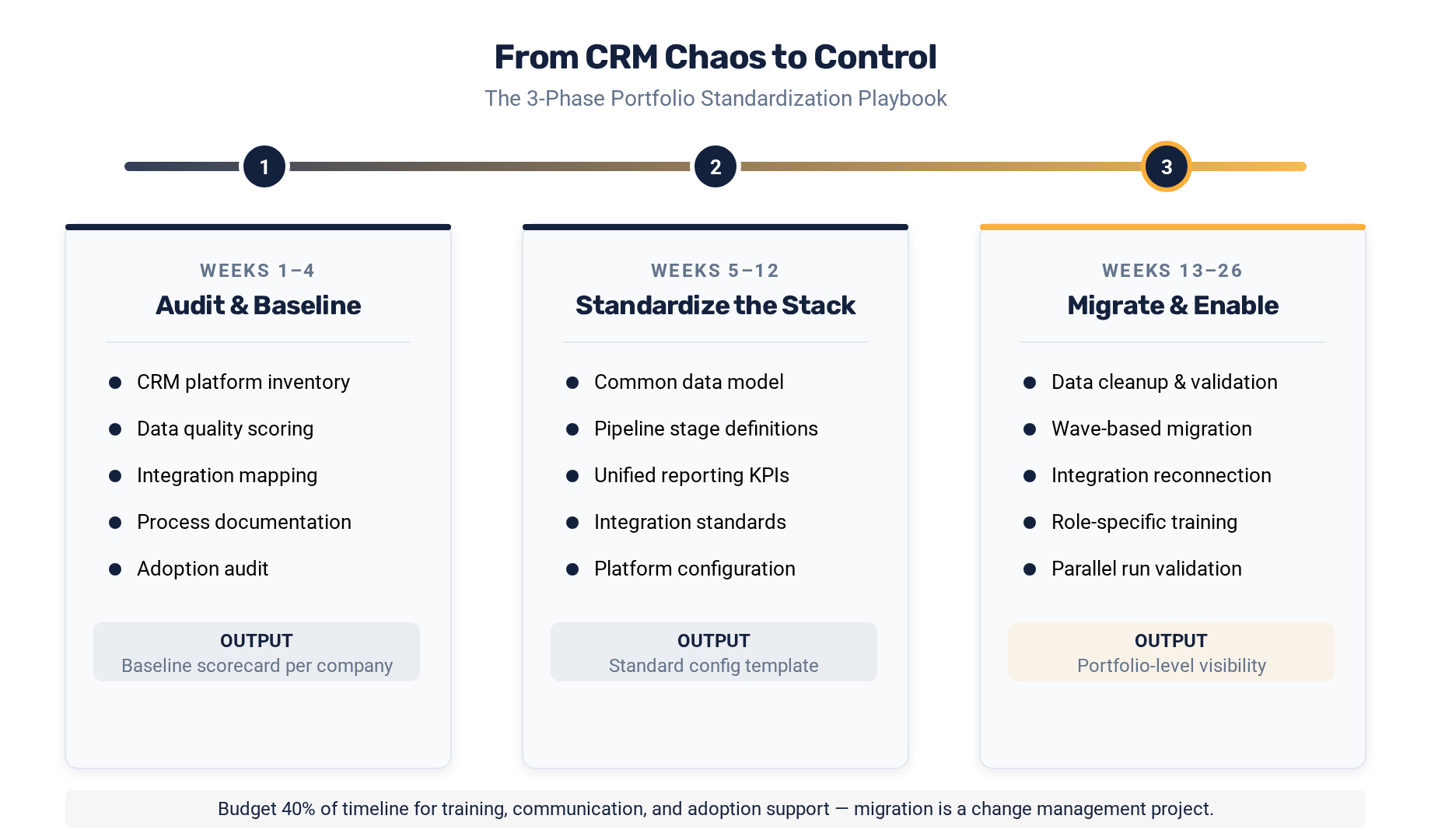
The 3-Step Playbook for Regaining Control
After managing CRM transformations across dozens of PE portfolios, we have refined a three-step approach that consistently delivers results while minimizing disruption.
Step 1: Audit and Baseline (Weeks 1-4)
Before making any technology decisions, you need a clear picture of what exists. Conduct a technology audit across every portfolio company that covers:
- Current CRM platforms and versions — including any shadow tools teams are actually using
- Data quality assessment — duplicate rates, field completion rates, record accuracy
- Integration inventory — what connects to the CRM and what breaks if you change it
- Process mapping — how deals actually move from lead to close, not how the documentation says they should
- User adoption metrics — who actually logs into the CRM and how often
This audit produces a baseline scorecard for each company that quantifies the current state. It also identifies the low-hanging fruit — companies with minimal CRM investment that can migrate quickly and companies with strong implementations that can serve as models.
Step 2: Standardize the Stack (Weeks 5-12)
With audit data in hand, select a standard platform and define the core configuration that every portfolio company will share. This does not mean every company runs an identical setup. It means every company shares:
- A common data model — the same core objects, properties, and naming conventions so data can roll up to portfolio-level reporting
- Standardized pipeline stages — consistent definitions for what constitutes a qualified opportunity, a proposal, and a closed deal
- Unified reporting framework — a shared set of KPIs that every company reports on, with flexibility for company-specific metrics on top
- Integration standards — approved connectors and data flow patterns that maintain data integrity
HubSpot is particularly well-suited for this because its multi-portal architecture allows each company to maintain its own instance while sharing a common configuration template. We documented this approach in detail when a PE-backed electronics distributor unified its fragmented CRM systems across multiple business units. The Operations Hub features enable cross-portal data sync without requiring a monolithic single-instance approach.
Step 3: Migrate and Enable (Weeks 13-26)
Execute migrations in waves, starting with the companies that have the least complex existing setups. Each wave follows the same pattern:
- Data cleanup — deduplicate, standardize, and validate data before it moves to the new system
- Configuration deployment — apply the standard template with company-specific customizations
- Integration reconnection — reestablish connections to ERP, marketing tools, and other systems
- User training — role-specific training that focuses on daily workflows, not feature tours
- Parallel running — two weeks of running both systems to validate data accuracy and catch gaps
The critical insight here is that migration is not a technology project — it is a change management project. Budget at least 40% of the timeline for training, communication, and adoption support.
Building the Portfolio-Level Data Layer
Once companies are on a standardized platform, the real value emerges: portfolio-level visibility. Build a reporting layer that gives operating partners:
- Cross-portfolio pipeline dashboard showing aggregate and company-level deal flow
- Benchmarking reports comparing conversion rates, sales velocity, and average deal size across companies
- Early warning indicators that flag when a company's pipeline health is deteriorating before it shows up in quarterly results
- Resource allocation insights that identify which companies would benefit most from additional sales or marketing investment
This data layer is the strategic asset that justifies the entire standardization effort. It transforms the operating partner's role from reactive problem-solver to proactive value creator.
Governance That Scales
Standardization without governance is temporary. Within 18 months, individual companies will drift back toward custom configurations and data practices unless you establish clear guardrails:
- Quarterly data quality audits with scorecards shared at portfolio reviews
- A shared CRM admin function — either centralized or as a community of practice across companies — that maintains configuration standards
- Change management protocols requiring approval for modifications to shared objects, properties, or pipeline stages
- Onboarding playbooks for new acquisitions that include technology integration in the first 100 days
The Payoff: From Chaos to Competitive Advantage
PE firms that successfully standardize CRM across their portfolios consistently report three outcomes: faster and more accurate board reporting, improved pipeline forecasting accuracy by 30-40%, and the ability to identify and act on cross-portfolio growth opportunities that were invisible before.
The journey from CRM chaos to control is not fast, and it is not painless. But the alternative — continuing to operate blind while competitors build data-driven portfolios — is far more expensive. The firms that treat CRM standardization as a strategic initiative rather than an IT project are the ones capturing the most value from their investments.
PE firms managing multiple portfolio companies face this chaos multiplied — every portco with its own CRM configuration, data standards, and reporting formats. The 100-Day CRM Integration Playbook provides the systematic approach for bringing acquired companies onto a unified platform.
Keep Reading
- The Complete HubSpot Guide for PE — The complete framework for the transformation.
- CRM Standardization Across PE Portfolio Companies — The detailed standardization playbook.
- PE Decision Framework — How to select the unified platform.
- PE Portfolio Reporting for Operating Partners — Unified reporting that results from control.
- 100-Day CRM Integration Playbook — The systematic approach to CRM integration after acquisition.
How healthy is your portfolio company's CRM? Take the free assessment — 7 minutes, instant results.