Marketing attribution is supposed to answer the most important question in the department: "Which marketing investments are driving revenue?" Instead, it has become a source of internal arguments, misleading reports, and misallocated budgets.
The problem is not that attribution models are poorly implemented — though many are. The problem is that the dominant attribution models are built on assumptions that no longer reflect how modern B2B buyers actually purchase.
Why Traditional Models Fail
First-Touch Attribution
First-touch gives 100% of the credit to the first marketing interaction. The blog post that attracted the visitor gets all the revenue credit, regardless of the 15 other touchpoints that happened before the deal closed.
The flaw: First-touch massively overvalues top-of-funnel content and awareness channels while giving zero credit to the nurture sequences, case studies, demos, and sales enablement content that actually moved the buyer toward a decision. It tells you how people find you but nothing about what convinces them to buy.
Last-Touch Attribution
Last-touch gives 100% of the credit to the final marketing interaction before the deal closed. The demo request form gets all the credit.
The flaw: Last-touch is even more misleading than first-touch. It gives full credit to the tipping point while ignoring everything that built the buyer's confidence over weeks or months. It leads teams to overinvest in bottom-of-funnel conversion tactics while starving the awareness and consideration content that feeds the funnel.
Multi-Touch Attribution
Multi-touch models — linear, U-shaped, W-shaped, time-decay — distribute credit across multiple touchpoints. This is an improvement, but the fundamental flaw remains: they all try to assign deterministic credit in a probabilistic process.
The flaw: Multi-touch models assume that every tracked touchpoint contributed to the purchase decision and that the relative contribution can be calculated from the sequence and timing of interactions. Neither assumption holds. Buyers consume content that does not influence their decision. They are influenced by interactions that are not tracked — peer recommendations, internal conversations, analyst reports, competitive research. The tracked touchpoints are an incomplete sample of the actual decision process.
The Hidden Failures
Beyond model selection, attribution fails for structural reasons that most organizations overlook.
Dark social and word-of-mouth. When someone hears about you from a colleague, researches your company, and then visits your website directly, attribution shows "Direct" as the source. The actual source — a trusted peer recommendation — is invisible. Studies suggest that 60-80% of B2B discovery involves dark social channels that attribution cannot track.
Multi-device journeys. A buyer researches on their phone during a commute, continues on their personal laptop at home, and converts on their work desktop. Unless your tracking spans all three sessions (which it rarely does), you lose most of the journey.
Committee buying. B2B purchases involve multiple stakeholders. The person who converts on your website may not be the person who drove the decision. Marketing may have influenced the CFO through a targeted ABM campaign, but attribution credits the VP of Operations who filled out the form.
Offline influences. Trade shows, dinner meetings, phone conversations, and conference presentations influence buying decisions but leave no digital footprint in your attribution system.
A Better Approach: Triangulated Measurement
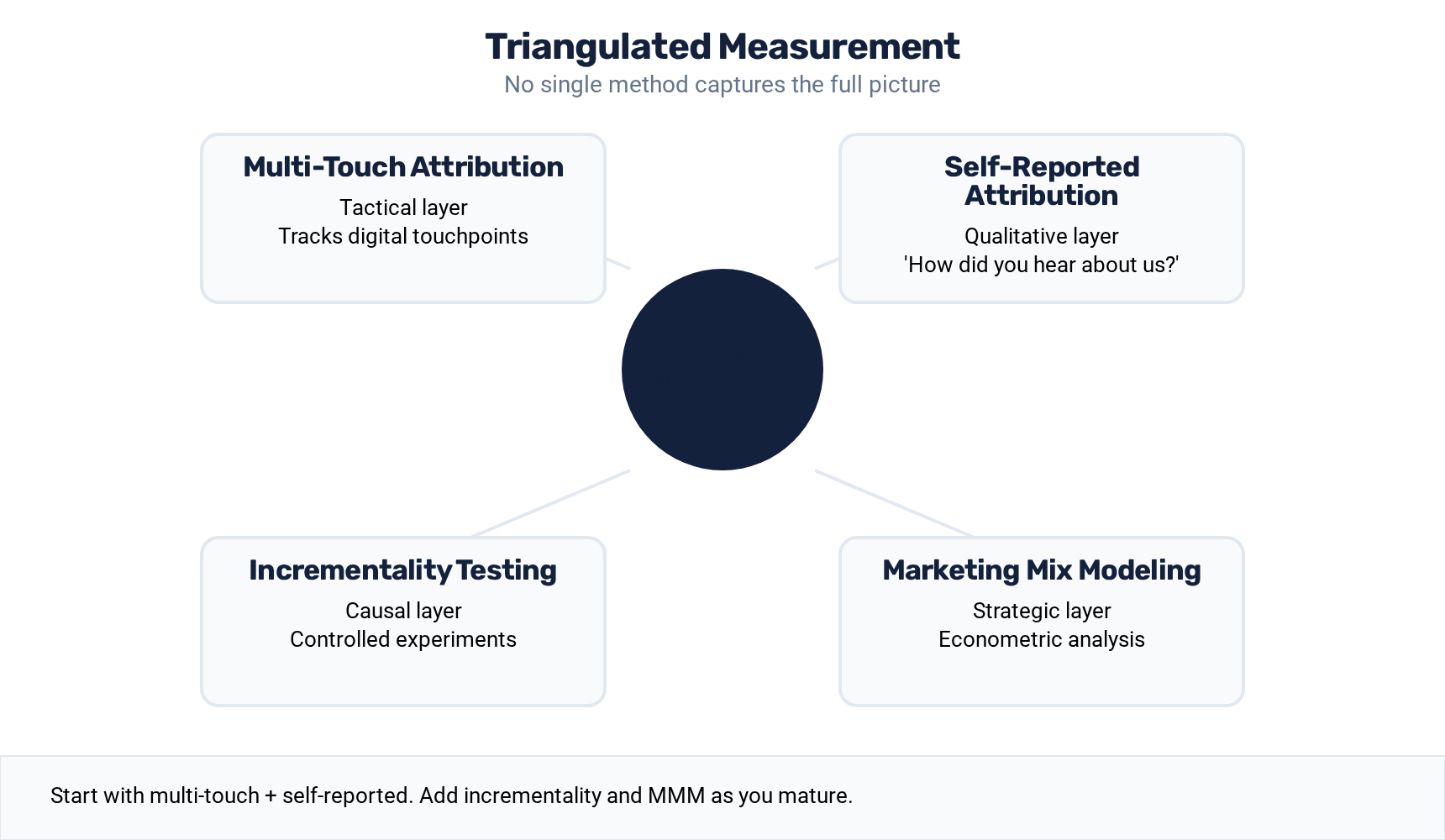
Since no single attribution method captures the full picture, sophisticated marketing organizations use a triangulated approach that combines multiple measurement methods.
Method 1: Multi-Touch Attribution (Tactical Layer)
Keep using multi-touch attribution, but understand its limitations. It is most useful for tactical optimization — understanding which specific campaigns, content pieces, and channels are generating engagement among accounts that eventually close.
In HubSpot, use the Attribution Report builder to analyze revenue credit across different models. Compare first-touch, last-touch, and W-shaped models side by side. The channels that show up consistently across models are your most reliable drivers.
Method 2: Self-Reported Attribution (Qualitative Layer)
Add a simple question to your high-intent forms and sales discovery calls: "How did you hear about us?" This captures the dark social and word-of-mouth influences that digital attribution misses entirely.
In HubSpot, create a dropdown property called "Self-Reported Source" with options that cover both trackable channels (Google Search, LinkedIn Ad) and untrackable ones (Colleague Recommendation, Podcast, Event, Industry Publication). Make it a required field on demo request and contact forms.
Analyze self-reported data alongside digital attribution data. When they diverge — when digital attribution says "Organic Search" but the buyer says "My colleague recommended you" — the self-reported answer is usually more accurate about what actually initiated the buying journey.
Method 3: Incrementality Testing (Causal Layer)
Incrementality tests measure the actual causal impact of marketing investments by comparing outcomes between exposed and unexposed groups.
The simplest version: pause a specific channel in a specific geography for 30 days and measure the change in pipeline creation compared to geographies where the channel remained active. If pipeline drops proportionally to the spend reduction, the channel is driving incremental results. If pipeline stays flat, the channel was getting credit for results that would have happened anyway.
This is the most rigorous measurement method but also the most operationally complex. Start with one test per quarter on your largest channel investment.
Method 4: Marketing Mix Modeling (Strategic Layer)
Marketing mix modeling uses statistical analysis to correlate marketing spend across channels with business outcomes over time. Unlike attribution, which assigns credit to individual touchpoints, MMM analyzes the aggregate impact of channel investments.
MMM is particularly valuable for budget allocation decisions — understanding the diminishing returns curve for each channel and identifying the optimal spend distribution. It requires 12-24 months of historical data and statistical expertise to implement, but the strategic insights are worth the investment.
Practical Steps to Improve Attribution Today
You do not need to overhaul your entire measurement framework overnight. Start with these immediate improvements.
Start with the basics: getting your UTM parameter strategy right is the foundation that every other attribution method depends on.
Implement self-reported attribution. Add the "How did you hear about us?" question to your high-intent forms today. This takes 10 minutes and immediately begins capturing data that digital attribution misses.
Use multiple attribution models. If you are only looking at one model, you are only seeing one perspective. In HubSpot, build attribution reports using at least three different models and look for convergence — channels that appear important across all models.
Track accounts, not just contacts. B2B buying is a team sport. Build attribution that follows account-level engagement, not just individual contact touchpoints. HubSpot's ABM tools allow you to aggregate engagement across contacts associated with the same company.
Accept imperfect measurement. Attribution will never provide a precise, deterministic answer to "which marketing dollar drove which revenue dollar." That precision is a myth. What attribution can provide is directional guidance — a probabilistic understanding of which investments are most likely driving results. That guidance, combined with qualitative signals and incrementality data, is enough to make dramatically better budget allocation decisions than intuition alone.
Attribution is not a technology problem to be solved with a better model. It is a measurement challenge to be addressed with multiple complementary methods that together provide a richer, more accurate picture of marketing's contribution to revenue.
Keep Reading
- Demystifying UTM Parameters — Proper UTMs improve attribution foundation.
- Analytics & BI Services — We use advanced attribution modeling.
- Marketing Data Management: Chaos to Clarity — Attribution needs a data foundation.
How healthy is your portfolio company's CRM? Take the free assessment — 7 minutes, instant results.