Every data governance initiative starts with the same optimism: clear policies are written, tools are configured, training is delivered, and leadership expresses full support. Six months later, compliance is spotty, workarounds are rampant, and the governance framework exists on paper but not in practice.
The failure is rarely technical. The policies were sound. The tools were adequate. What failed was the human element — the psychology of how people respond to rules about data. Until you understand why teams resist governance, you cannot build governance that sticks.
Why People Resist Data Governance
The Ownership Problem
Data governance asks people to follow rules for data they feel they own. A sales rep who spent 30 minutes researching a prospect and entering their information into the CRM views that record as their work product. When governance policies dictate how they should format, categorize, and maintain that record, it feels like interference with their work.
This sense of ownership is strongest among your best performers. Top reps have developed their own systems for managing information — systems that work for them. Asking them to change their approach in service of organizational data quality feels like a penalty for being effective.
The insight: Frame governance as a tool that protects their work, not one that controls it. When reps understand that standardized data makes their pipeline reports more accurate and their lead routing more reliable, resistance decreases because the benefit is personal and tangible.
The Immediacy Bias
Data governance provides long-term benefits — better reporting, more accurate forecasting, cleaner segmentation — at the cost of short-term effort. Every additional field a rep fills out, every naming convention they remember, every categorization decision they make takes a few seconds of their day.
Humans are wired to value immediate effort more heavily than future reward. A rep who is rushing to log a call before their next meeting will skip the optional fields every time, because the cost of filling them is immediate and the benefit of having them is abstract.
The insight: Reduce the immediate cost. Minimize required fields to the true essentials. Use dropdowns instead of free text. Implement auto-population through workflows and integrations. The less effort governance requires in the moment, the higher compliance will be.
The Invisibility of Consequences
When a rep leaves a field blank or enters inconsistent data, nothing happens — immediately. No error message. No warning. No consequence. The damage manifests weeks or months later in a broken report, a misrouted lead, or an inaccurate forecast. By then, the connection between the data entry shortcut and the downstream consequence is invisible.
The insight: Make consequences visible and immediate. Build dashboards that show data quality scores by team and individual. Send weekly automated reports highlighting incomplete records. Create a direct feedback loop between data entry and data outcomes so people can see the connection.
The Compliance vs. Commitment Gap
There is a critical difference between people complying with governance rules and people being committed to data quality. Compliance means following the rules when someone is watching. Commitment means following them because you understand their value.
Most governance programs achieve compliance at best. People fill in the required fields because the system forces them to, but they do it with the minimum viable effort — selecting the first dropdown option, entering placeholder text, or copying data from the previous record.
The insight: Build commitment through involvement. When people help design the governance rules, they are more likely to follow them. Include representatives from sales, marketing, and customer success in your governance design process. Their input will make the rules more practical, and their participation will make adoption more organic.
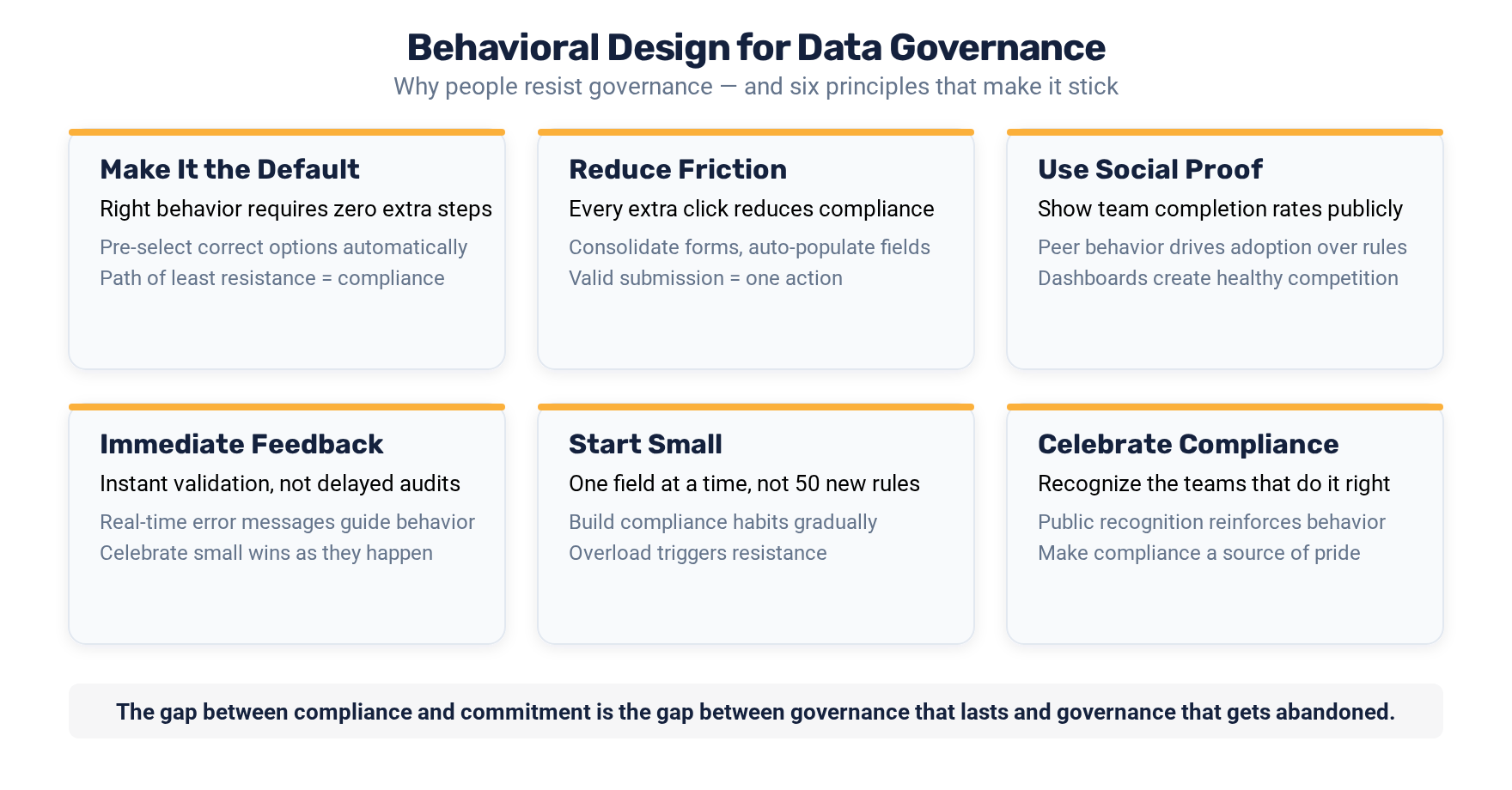
Behavioral Design Principles for Data Governance
Effective data governance borrows from behavioral science — designing systems that make good behavior easy and bad behavior difficult.
Make the Right Thing the Default
Defaults are powerful. When HubSpot properties have sensible default values, when lifecycle stages auto-populate based on behavior, and when data standardization happens through automation rather than manual effort, governance happens without anyone thinking about it.
Design your CRM so that doing nothing produces compliant data. If a record is created and the user takes no action, the automated systems should still produce a minimally clean record — lifecycle stage set by workflow, source tracked automatically, company association populated by domain matching.
Reduce Friction at Every Step
Every click, every field, every decision point in the data entry process is friction. Audit your CRM forms and record layouts with fresh eyes.
- Do reps need to enter a company name, or can HubSpot auto-populate it from the email domain?
- Do reps need to type a job title, or can they select from a categorized dropdown?
- Do reps need to manually update deal stages, or can guided selling prompts walk them through the required information at each stage?
- Can you reduce the number of visible fields to show only what is relevant at each stage of the process?
In HubSpot, use conditional property logic and required field validation to create a guided experience. Show Stage 1 fields during Stage 1 and Stage 2 fields during Stage 2. This reduces cognitive load and improves data quality simultaneously.
Use Social Proof
People conform to what they see others doing. If a rep believes that nobody else fills out the "Lead Source Detail" field, they will not either. If they can see that 90% of the team fills it out and their non-compliance is visible, behavior changes.
Build leaderboards or scorecards that show data quality metrics by team. Not as a punishment tool — as a visibility tool. When data quality is visible and social, the natural human desire to conform pulls behavior in the right direction.
Provide Immediate Feedback
When someone enters data that violates governance rules, tell them immediately. Do not wait for a monthly audit to surface the issue. HubSpot's validation rules can reject non-standard values at the point of entry. Workflow-based alerts can notify record owners when their records fall below quality thresholds.
The tighter the feedback loop between action and consequence, the faster behavior changes.
Building Governance That Sticks
Start Small
The most common governance failure is trying to do too much at once. Launching a 50-page data governance policy that covers every property, every process, and every edge case guarantees that nobody reads it and nobody follows it.
Start with five rules. Pick the five data quality issues that cause the most pain — duplicate records, missing deal amounts, inconsistent lead sources, blank company fields, wrong lifecycle stages — and build governance around just those five. Once compliance on those five is above 90%, add five more.
Celebrate Compliance
Governance programs are usually all stick and no carrot. People hear about governance when they are doing it wrong, never when they are doing it right.
Flip the dynamic. Recognize teams and individuals with the highest data quality scores. Mention them in team meetings. Show the correlation between data quality and sales results — teams with cleaner data close at higher rates, forecast more accurately, and waste less time on administrative fixes.
Evolve Continuously
Governance is not a launch-it-and-forget-it initiative. Business processes change, new tools are added, team structures shift, and governance rules need to adapt. Schedule quarterly governance reviews that assess which rules are working, which are creating unnecessary friction, and which gaps have emerged.
Invite frontline users to these reviews. They experience the governance rules daily and have practical insights about what works and what creates unproductive overhead. For PE firms managing multiple portfolio companies, standardizing CRM governance practices across the entire portfolio introduces additional behavioral dynamics — what works at one portco may not scale uniformly across others without cultural adjustment.
The psychology of data governance is ultimately about aligning individual incentives with organizational needs. When governance is designed with human behavior in mind — reducing friction, providing immediate feedback, leveraging social dynamics, and connecting personal benefit to organizational benefit — it transitions from a policy people tolerate to a practice people embrace.
Keep Reading
- CRM Standardization Across PE Portfolio Companies — Standardization requires governance adoption.
- Revenue Operations Maturity Model — Governance is a component of higher maturity.
- Building a RevOps Function — RevOps drives governance adoption.
- Team Training Services — Training helps teams understand why governance matters.
How healthy is your portfolio company's CRM? Take the free assessment — 7 minutes, instant results.