Sales and marketing misalignment is not news. Every B2B organization knows it exists. What most organizations underestimate is how much it costs — and how deeply structural the problem really is. This is not a communication issue that gets solved with a joint meeting. It is a systemic failure that requires executive leadership to fix.
The Cost of the Divide
The financial impact of sales-marketing misalignment is diffuse, which makes it easy to overlook. It does not show up as a single line item. Instead, it bleeds revenue across multiple areas simultaneously.
Wasted marketing spend. When marketing generates leads that sales ignores, the entire investment in acquiring those leads — ad spend, content production, tool costs, team time — is wasted. If 50% of marketing leads go unworked, half the marketing budget effectively produces nothing.
Lost pipeline from slow or absent follow-up. Leads that sit in a queue for days or weeks lose interest. Research shows that conversion rates drop by 80% after the first five minutes. Misalignment between lead handoff and sales follow-up is the primary cause of delayed response.
Duplicate efforts. When marketing and sales do not share content, insights, or account intelligence, both teams independently research the same accounts, produce overlapping content, and develop redundant messaging. The duplicated effort across a 20-person combined team easily exceeds $200,000 annually.
Inconsistent buyer experience. When marketing messages "digital transformation" and sales pitches "cost reduction," the prospect receives a disjointed experience that undermines trust. Mixed messaging extends sales cycles and reduces win rates.
Forecast inaccuracy. When marketing and sales use different definitions for pipeline stages, lead quality, and revenue attribution, forecasts are unreliable because the input data does not reconcile. Leadership makes resource decisions based on numbers that marketing and sales interpret differently.
Research from various industry sources estimates that misalignment costs the average B2B company 10% or more of annual revenue. For a $50M company, that is $5M — enough to fund an entirely new growth initiative.
Why Alignment Efforts Fail
Most organizations have tried to fix alignment. They have held joint planning sessions, created SLAs, shared dashboards, and moved desks together. Yet the divide persists. Here is why.
Misaligned Incentives
Marketing is measured on leads generated. Sales is measured on revenue closed. These metrics create fundamentally different optimization behaviors.
Marketing optimizes for volume — more leads, more MQLs, more form submissions. The easiest way to hit lead targets is to lower the quality bar: broader targeting, less qualifying content, lower thresholds.
Sales optimizes for conversion — working the leads most likely to close and deprioritizing everything else. The easiest way to hit revenue targets is to ignore low-converting leads and focus on self-sourced opportunities.
Both teams are behaving rationally within their incentive structure. The incentive structure itself is the problem.
Different Data, Different Truth
Marketing reports from HubSpot. Sales reports from their CRM pipeline view (also HubSpot, but configured differently). Finance reports from the billing system. Each system shows a different version of reality because the data definitions, time periods, and calculation methods are not standardized.
When each team has their own version of the truth, every cross-functional conversation becomes an argument about whose numbers are right rather than a discussion about what to do.
No Shared Accountability
In most organizations, marketing owns the top of the funnel and sales owns the bottom. The middle — where MQLs become SQLs and SQLs become opportunities — is a no-man's land that neither team fully owns.
This gap is where the most valuable work happens: lead qualification, needs assessment, and buyer enablement. When nobody is accountable for the middle, leads fall through cracks, handoffs are sloppy, and the pipeline suffers.
Leadership Dysfunction
The most uncomfortable truth is that the sales-marketing divide usually mirrors a leadership divide. When the CMO and CRO do not have a productive working relationship — or when they compete for budget, headcount, and executive attention — their teams absorb and amplify that tension.
Alignment cannot be mandated from the bottom up. It must be modeled from the top down.
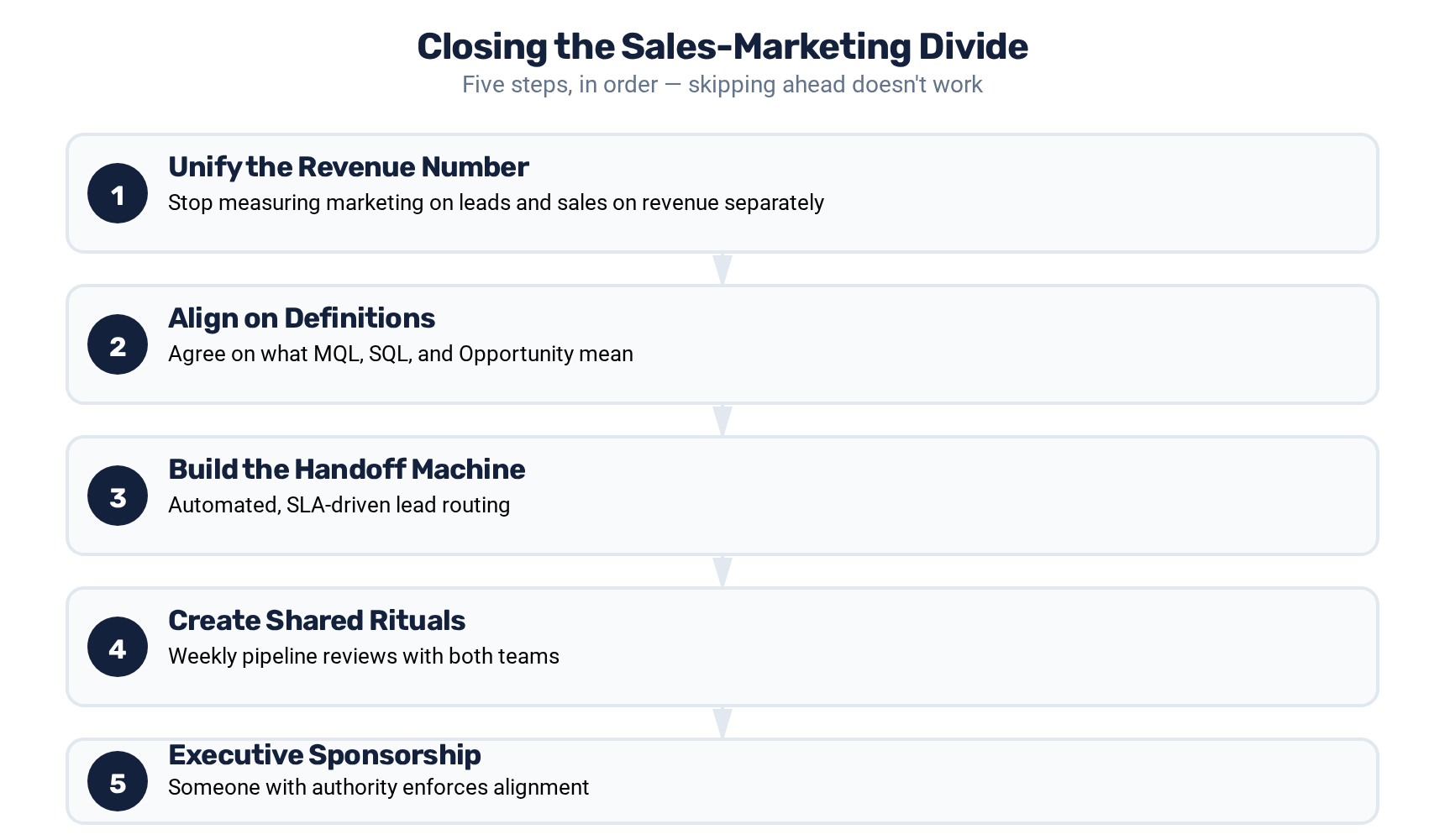
How to Actually Fix It
Step 1: Unify the Revenue Number
Stop measuring marketing on leads and sales on revenue. Create a shared metric that both teams are accountable for: marketing-sourced pipeline or marketing-influenced revenue.
This single change transforms the dynamic. Marketing now cares about whether their leads convert because their metric depends on it. Sales now cares about working marketing leads because the pipeline they generate is tracked. Both teams optimize toward the same outcome. A revenue operations maturity model helps you benchmark where your organization stands on cross-functional alignment before prescribing fixes.
In HubSpot, build a report that tracks pipeline created from marketing-sourced leads (contacts with an original source attribution to a marketing channel). Share this report as a standing agenda item in the joint weekly meeting.
Step 2: Align on Definitions
Hold a joint workshop — not a presentation, a working session — to align on definitions for every stage of the funnel.
What is a lead? What minimum criteria must a contact meet?
What is an MQL? What scoring threshold or behavioral criteria trigger the handoff to sales?
What is an SQL? What does sales need to confirm before pursuing a lead?
What is an opportunity? What criteria must be met to create a deal?
Document these definitions. Put them in a shared location. Reference them in every pipeline review. When someone uses one of these terms, everyone should mean the same thing.
Step 3: Build the Handoff Machine
The MQL-to-SQL handoff is the most critical process in the revenue engine, and it is where most organizations fail. Build it as an automated, tracked, and accountable process.
Automation: When a lead hits MQL criteria in HubSpot, a workflow should instantly assign it to the right rep, create a follow-up task, send a notification, and log the timestamp.
Tracking: Measure time-to-first-contact, acceptance rate, rejection rate (with reasons), and conversion rate for every handed-off lead.
Accountability: Review handoff metrics weekly. When leads are not being worked within the SLA, the data makes it visible immediately.
Step 4: Create Shared Rituals
Alignment requires regular, structured interaction between the teams. Establish three recurring touchpoints:
Weekly pipeline sync (30 minutes): Marketing and sales leadership review MQL volume, handoff metrics, pipeline creation, and any immediate issues. This is operational — focused on this week's numbers and next week's actions.
Monthly strategy session (60 minutes): Review channel performance, lead quality trends, conversion rates by source, and campaign effectiveness. This is tactical — focused on what is working, what is not, and what to adjust.
Quarterly planning review (half day): Align on targets for the next quarter, review ICP and targeting strategy, plan major campaigns, and adjust the SLA based on the previous quarter's data. This is strategic — focused on direction and resource allocation.
Step 5: Executive Sponsorship
The CMO and CRO (or their equivalents) must visibly champion alignment. This means attending the joint meetings, holding their teams accountable for shared metrics, resolving cross-team conflicts promptly, and never publicly blaming the other team.
When leadership models alignment, teams follow. When leadership blames, teams blame.
Measuring Progress
Track these metrics to gauge whether alignment is improving:
- Lead follow-up rate: Percentage of MQLs contacted within the SLA window (target: above 90%)
- Lead acceptance rate: Percentage of MQLs accepted by sales (target: above 70%)
- Marketing-sourced pipeline: Dollar value of pipeline from marketing leads (target: growing quarter over quarter)
- Sales cycle for marketing leads vs. sales-sourced leads: Should converge over time as lead quality improves
- Combined team NPS: Survey both teams quarterly on their perception of cross-functional collaboration
The sales-marketing divide will not close overnight. It took years to build and it will take quarters to dismantle. But every step toward alignment produces measurable revenue improvement. The companies that bridge this divide do not just perform better — they build a compounding advantage that misaligned competitors cannot replicate.
In PE portfolio companies, the sales-marketing divide is compounded by the need for standardized operations across multiple investments. Operating partners who mandate alignment as part of the value creation plan see faster revenue growth than those who leave it to individual portco leadership.
Keep Reading
- Building a RevOps Function — RevOps exists to bridge this divide.
- Why Your Sales Team Is Ignoring Marketing Leads — Lead ignoring is a manifestation of the divide.
- Marketing Operations & RevOps Services — We align sales and marketing operations.
How healthy is your portfolio company's CRM? Take the free assessment — 7 minutes, instant results.