You just stepped into a Revenue Operations leadership role. The expectations are enormous — align sales, marketing, and customer success around a unified revenue engine. But the reality you walked into is messy: disconnected systems, tribal process knowledge, conflicting metrics, and political land mines between departments.
The first 90 days determine whether your RevOps function becomes a strategic powerhouse or gets reduced to a reporting service. Here is the playbook that separates successful RevOps leaders from those who stall out.
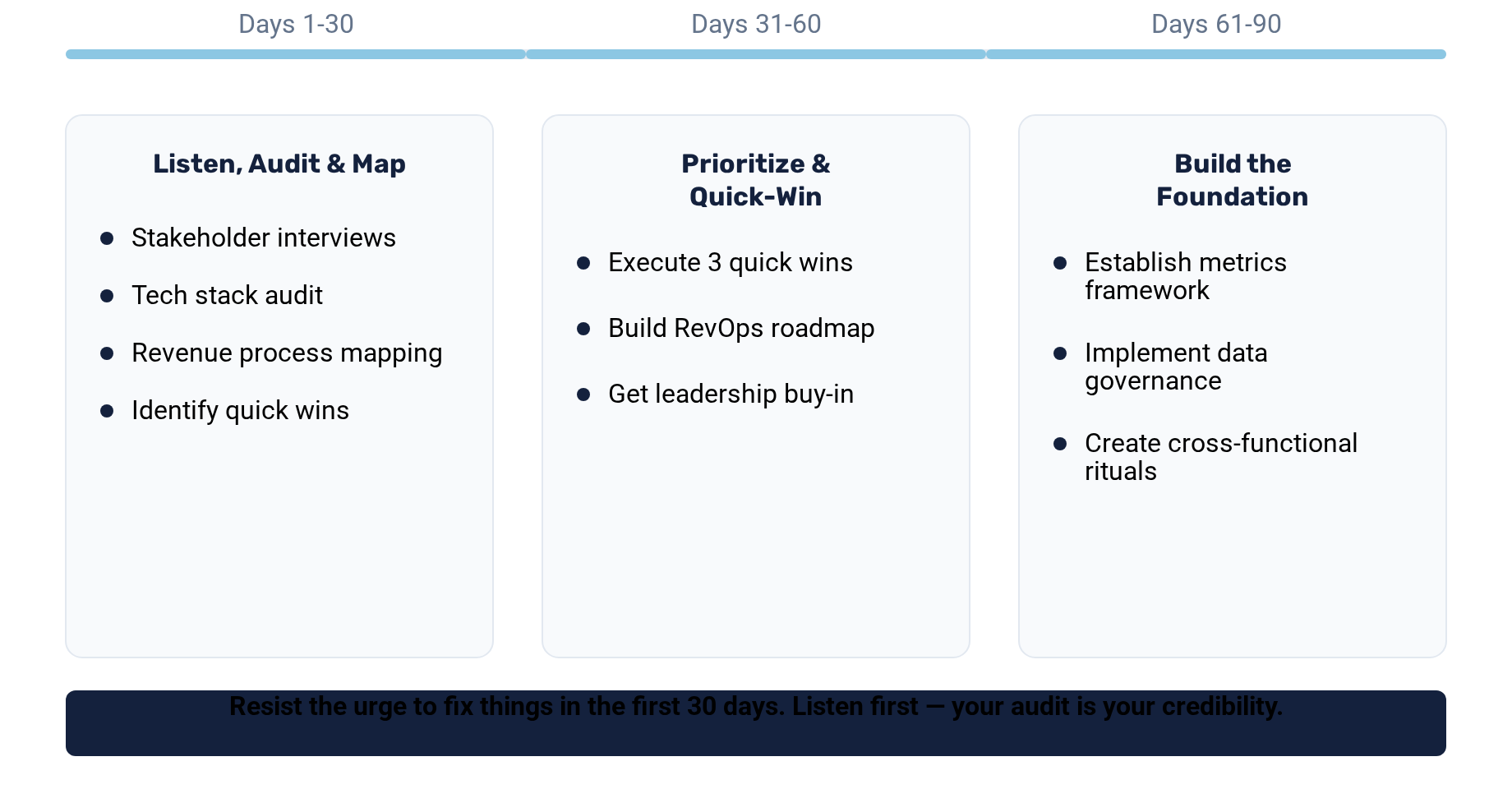
Days 1-30: Listen, Audit, and Map
Your first instinct will be to fix things. Resist it. The first 30 days are for listening and learning. Every change you make before understanding the full picture risks solving the wrong problem or creating new ones.
Conduct Stakeholder Interviews
Schedule 30-minute conversations with every revenue-facing leader: VP of Sales, CMO, Head of Customer Success, CFO, and their direct reports. Ask each person the same questions:
- What is your biggest operational bottleneck right now?
- How do you define a qualified lead? A qualified opportunity? A healthy customer?
- What reports do you pull regularly, and how much do you trust the data?
- Where do handoffs between teams break down?
- What did the last person in this role get right? What did they get wrong?
Do not try to solve anything during these conversations. Your goal is to build a map of how the organization actually operates — which will differ significantly from the org chart and the documented processes.
Audit the Tech Stack
Document every tool in the revenue technology stack: CRM, marketing automation, sales engagement, customer success platform, billing, analytics, and the shadow tools people use because the official tools do not work. For each tool, record:
- What it is used for
- Who owns it
- How many active users it has
- What it integrates with (and whether those integrations actually work)
- Annual cost
This audit almost always reveals redundant tools, broken integrations, and orphaned platforms that nobody owns but everyone blames. If you are stepping into this role during or after an acquisition, the post-acquisition technology integration playbook provides a more targeted framework for navigating which systems to consolidate and in what sequence.
Map the Revenue Process
Document the actual end-to-end journey from first touch to closed deal to renewal. Not the aspirational process — the real one. Where does a lead originate? How does it get qualified? When does sales engage? What happens after a deal closes? Where does the process break down?
Map this visually. A single flowchart showing the handoff points between marketing, sales, and customer success will reveal gaps, redundancies, and misalignments that no amount of meetings will surface.
Days 31-60: Prioritize and Quick-Win
With your audit complete, you now have a prioritized list of problems. The temptation is to tackle the biggest one first. Do not. Start with quick wins that build credibility and political capital.
Identify Three Quick Wins
A quick win meets three criteria: it can be completed in two weeks or less, it visibly improves someone's daily experience, and it does not require organizational change or budget approval.
Examples of effective quick wins:
- Fix the broken dashboard. Every organization has a dashboard that leadership checks but nobody trusts. Clean up the data source, fix the filters, and make it accurate. When the VP of Sales suddenly has a pipeline report they can rely on, you have earned trust.
- Automate a manual handoff. Find a process where someone is manually emailing leads to a rep or copying data between systems. Automate it with a workflow. The time savings are immediate and visible.
- Standardize a definition. If sales and marketing define "qualified lead" differently (they always do), facilitate a 60-minute session to align on a shared definition and document it. This single alignment unlocks downstream improvements.
Build the RevOps Roadmap
While executing quick wins, develop a 6-12 month roadmap that addresses the strategic priorities identified in your audit. Structure it in quarters:
- Q1 (current): Quick wins, data quality foundation, baseline metrics
- Q2: Process standardization, tech stack rationalization, reporting framework
- Q3: Automation maturity, advanced analytics, forecasting improvement
- Q4: Predictive modeling, capacity planning, strategic optimization
Present this roadmap to your executive sponsor and key stakeholders. Get buy-in on priorities and resource allocation before moving to execution.
Days 61-90: Build the Foundation
With quick wins delivered and the roadmap approved, use the final 30 days to build the operational foundation that everything else depends on.
Establish the Metrics Framework
Define the core metrics that your revenue organization will track. These should cascade from company-level goals down to team and individual metrics.
Company-level: Revenue growth rate, net revenue retention, customer acquisition cost, lifetime value
Pipeline-level: Pipeline coverage ratio, stage conversion rates, sales cycle length, average deal size, win rate
Team-level: Marketing-sourced pipeline, MQL-to-SQL conversion rate, SQL-to-opportunity rate, rep activity metrics, customer health scores
For each metric, document the definition, the data source, the calculation method, and the owner. This eliminates the "we measure that differently" problem that derails every cross-functional conversation.
Implement Data Governance
Data quality is the foundation of everything RevOps does. If the data is unreliable, every report, forecast, and analysis built on top of it is unreliable too.
Establish basic governance in the first 90 days:
- Required fields on deal records that reps must complete before advancing pipeline stages
- Standardized picklist values for key fields like lead source, industry, and deal type
- Automated data validation workflows that flag incomplete or inconsistent records
- Regular data quality reporting — a weekly email to team leads showing data completeness and accuracy scores for their teams
Create Cross-Functional Alignment Rituals
RevOps lives at the intersection of sales, marketing, and customer success. Without regular cross-functional touchpoints, alignment erodes naturally.
Establish these recurring meetings in your first 90 days:
- Weekly pipeline review with sales leadership, using standardized data and consistent definitions
- Monthly marketing-sales alignment covering lead quality, handoff metrics, and campaign performance
- Quarterly revenue review with all revenue leaders, analyzing full-funnel performance and adjusting strategy
The Patterns That Predict Success
After working with RevOps leaders across dozens of organizations, we see clear patterns in who succeeds and who does not.
Successful RevOps leaders spend their first 30 days listening, deliver visible wins in days 31-60, and build institutional infrastructure in days 61-90. They earn credibility through action before proposing large-scale change. They treat data quality as a strategic priority, not an administrative chore. And they measure themselves against business outcomes — revenue growth, forecast accuracy, customer retention — not activity metrics.
Struggling RevOps leaders try to fix everything at once, underestimate political dynamics, get sucked into tactical reporting requests, or attempt large-scale change without first building the relationships and credibility to execute it.
The first 90 days are not about transforming the organization. They are about building the foundation — the relationships, the data, the processes, and the credibility — that makes transformation possible in the months that follow.
In PE-backed companies, the first 90 days are even more compressed — operating partners expect revenue operations visibility from day one. The Revenue Operations Maturity Model provides the scoring framework that new RevOps leaders can use to baseline their company's position and build the roadmap.
Keep Reading
- PE Implementation Roadmap — 90-day implementation aligned with your critical window.
- Revenue Operations Maturity Model — Assess current state maturity to inform priorities.
- Building a RevOps Function — The RevOps team you're building around.
- Why 64% of PE Portfolio Companies Fail at HubSpot — Early intervention prevents these patterns.
How healthy is your portfolio company's CRM? Take the free assessment — 7 minutes, instant results.