When a HubSpot implementation fails, the line-item costs are obvious — wasted license fees, consultant hours, and migration expenses. But these visible costs represent maybe 20% of the actual damage. The real costs are hidden, compounding, and far more destructive than most organizations realize.
After rescuing dozens of failed implementations, we have mapped the full cost landscape. Understanding it is the first step toward either preventing failure or recognizing when a rescue is needed.
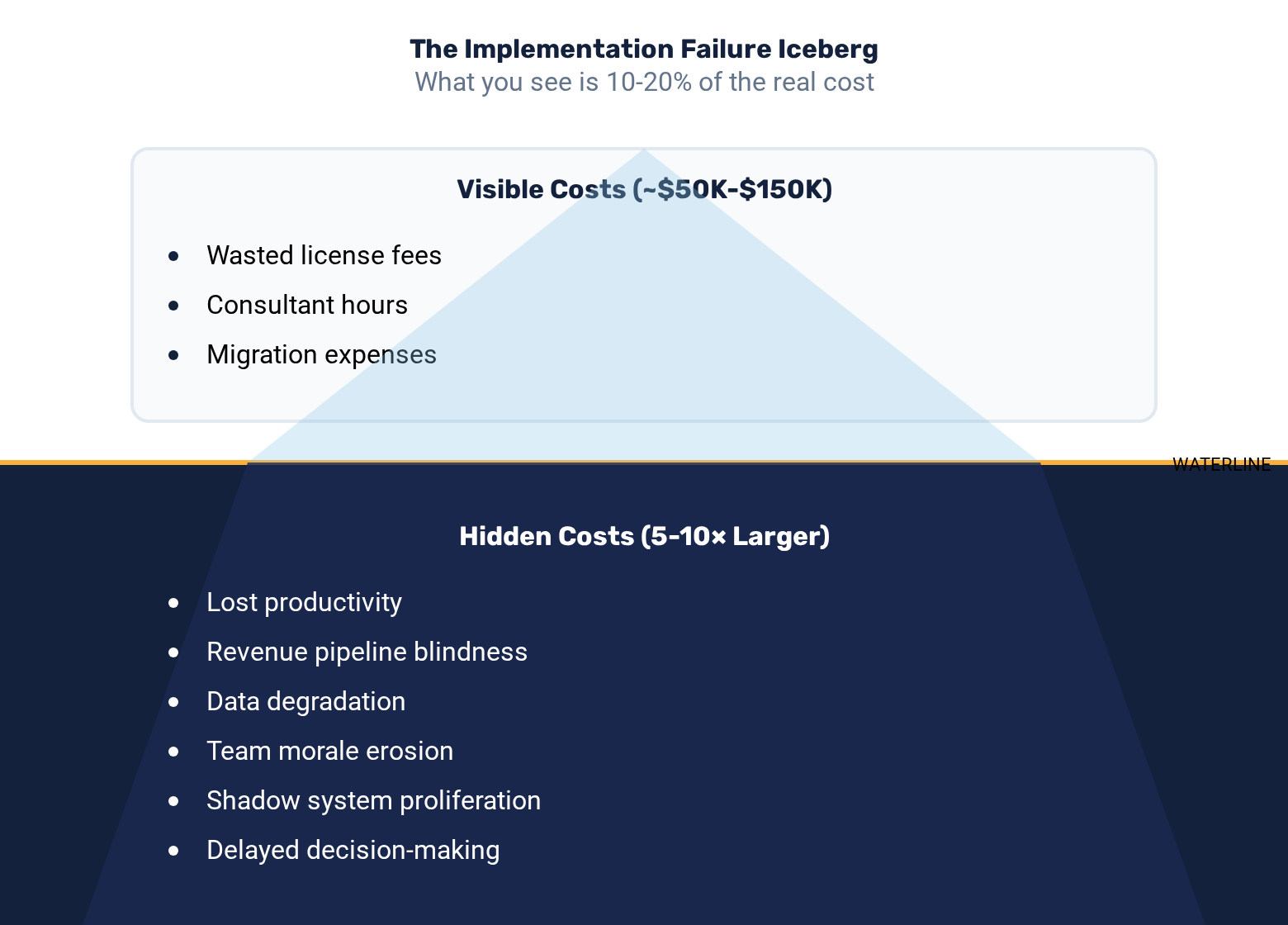
The Visible vs. Hidden Cost Iceberg
Most companies calculate implementation failure costs by adding up direct expenses: the HubSpot subscription, the implementation partner's fees, and the internal hours spent on the project. For a mid-market company, that typically totals $50,000-$150,000.
But the iceberg below the waterline is five to ten times larger.
Lost productivity during the failed rollout. Every hour your team spent in training sessions, data entry, and workflow testing for a system they will not use is time stolen from revenue-generating activities. For a sales team of 20, a three-month failed implementation consumes roughly 1,200 hours of productive selling time.
Revenue impact of pipeline blindness. Without a functioning CRM, your sales leadership is flying blind. Deals slip through cracks. Follow-ups get missed. Forecasting becomes guesswork. We estimate that companies with failed CRM implementations lose 10-15% of their addressable pipeline to poor visibility alone.
Data degradation. Once a CRM implementation fails and teams revert to spreadsheets and email, the data in the system begins to decay immediately. Contacts go unupdated. Deals stay in wrong stages. Within six months, the data is so unreliable that any future implementation requires a complete data rebuild.
Team morale and trust erosion. This is the cost nobody puts on a spreadsheet but everyone feels. When you ask a sales team to adopt a new system and it fails, they become deeply skeptical of the next attempt. That skepticism translates to passive resistance, slower adoption, and a higher bar for the rescue implementation to clear.
Opportunity cost of delayed transformation. Every month your organization operates without a functioning CRM is a month your competitors with working systems are pulling ahead. They are making data-driven decisions. You are making gut-feel guesses.
The Six Warning Signs Your Implementation Is Failing
Failed implementations do not collapse overnight. They deteriorate over weeks and months, showing clear warning signs that are easy to spot if you know what to look for.
1. Login frequency is declining. Track daily active users from week one. If the number drops more than 20% after the first month, you have an adoption problem. In HubSpot, you can monitor this through the usage logs in Settings.
2. Data entry is incomplete. When reps consistently leave required fields blank or enter placeholder data, they are telling you the system does not fit their workflow. Check field completion rates on deal records — anything below 80% on key fields is a red flag.
3. Shadow systems are emerging. If team members are maintaining their own spreadsheets, Notion databases, or sticky note systems alongside HubSpot, the CRM has failed to become the single source of truth. Ask directly: "Where do you track your deals?" If the answer is not "HubSpot," you have a problem.
4. Automation is not firing. Build simple workflow monitors that track whether key automations — lead assignment, deal stage notifications, task creation — are executing as designed. Broken automation means users are not following the intended process.
5. Leadership is not using reports. If your sales managers and executives are still requesting manual reports instead of pulling dashboards from HubSpot, the reporting layer has not been configured to answer their actual questions.
6. The implementation partner has gone quiet. A good partner stays engaged through adoption. If your implementation partner declared victory at go-live and disappeared, they left before the hardest part of the project.
Why Implementations Fail: Root Causes
Understanding root causes prevents you from repeating the same mistakes in a rescue.
Insufficient discovery. The implementation was configured based on assumptions about how the business operates rather than documented observations of actual workflows. The resulting system does not match reality.
Over-engineering. The implementation tried to automate every possible scenario from day one, creating a complex system that users find confusing and that breaks when edge cases arise. The best implementations start simple and add complexity gradually.
Inadequate data migration. Data was moved to HubSpot without proper cleaning, mapping, or validation. Duplicates, missing fields, and inconsistent formats poisoned the new system before it had a chance to prove its value.
No executive sponsor. Without a senior leader actively championing the CRM and holding teams accountable for using it, adoption is voluntary. And voluntary adoption in a busy organization means no adoption.
Wrong implementation partner. Generalist agencies and freelancers who list HubSpot among dozens of capabilities rarely have the depth of expertise needed for complex implementations. Specialized HubSpot partners with relevant industry experience deliver fundamentally different outcomes.
The 90-Day Rescue Plan
If you recognize the warning signs in your organization, here is the framework we use to rescue failed implementations.
Days 1-15: Triage and Assessment
Conduct an honest assessment of the current state. Interview users at every level — executives, managers, individual contributors — to understand what is not working and why. Audit the HubSpot configuration against actual business processes. Identify the gaps between how the system was built and how the business operates.
The output is a prioritized list of fixes ranked by impact on daily user experience.
Days 16-45: Core Fixes and Quick Wins
Address the highest-impact issues first. Reconfigure pipeline stages to match real sales processes. Fix data quality issues that are causing daily frustration. Simplify overly complex workflows. Remove unused properties that clutter the interface.
Critically, deliver at least three visible improvements that users notice in their daily work within this window. Quick wins rebuild trust faster than any communication campaign.
Days 46-75: Rebuild Adoption
With the core fixes in place, relaunch training focused on the improved system. Use role-specific sessions — what reps need is different from what managers need. Implement accountability measures: pipeline reviews must use HubSpot data, forecasts must come from CRM reports, and deal progression must be tracked in the system.
Days 76-90: Measure and Optimize
Establish baseline metrics for the rescued implementation: daily active users, data completeness, pipeline accuracy, and report usage. Set 30-day targets for improvement on each metric. Assign ongoing ownership for CRM health monitoring. This approach drove measurable results when a premium home improvement manufacturer rebuilt its HubSpot implementation using this framework, delivering a 40% improvement in adoption within the 90-day window.
Preventing the Next Failure
The most expensive implementation is the one you have to do twice. After a rescue, embed these practices to prevent recurrence:
- Monthly CRM health checks reviewing adoption, data quality, and automation performance
- Quarterly user feedback sessions that surface friction points before they become adoption killers
- Annual configuration reviews that ensure the system evolves with the business
- Documented change management processes so modifications are tested before they hit production
A failed HubSpot implementation is not the end of the road. But the cost of rescue is always higher than the cost of doing it right the first time. Invest in proper discovery, qualified partners, and adoption planning upfront — the hidden costs of failure are too significant to treat implementation as an afterthought.
These failure costs multiply across a PE portfolio — if one portco's implementation fails, it undermines confidence in the platform across the entire investment thesis. The Complete HubSpot Guide for PE outlines the playbook that prevents these failures from the start.
Keep Reading
- PE Implementation Roadmap — Structured roadmap that prevents these failure modes.
- Why 64% of PE Portfolio Companies Fail at HubSpot — The failure patterns behind these costs.
- The True Cost of a Failed CRM Implementation — Detailed financial analysis of failure.
- How to Evaluate a Portfolio Company's HubSpot — Identify warning signs early.
- The Complete HubSpot Guide for PE — The comprehensive framework that prevents these failures.
How healthy is your portfolio company's CRM? Take the free assessment — 7 minutes, instant results.