Private equity firms pour significant capital into technology transformations for their portfolio companies, and HubSpot is increasingly the platform of choice. Yet the implementation failure rate is staggering. Based on our work across PE-backed companies, roughly 64% of HubSpot implementations fail to deliver meaningful ROI within the first 18 months.
That is not a technology problem. It is an execution problem rooted in how PE firms approach CRM implementations — and the patterns behind these failures are both predictable and preventable.
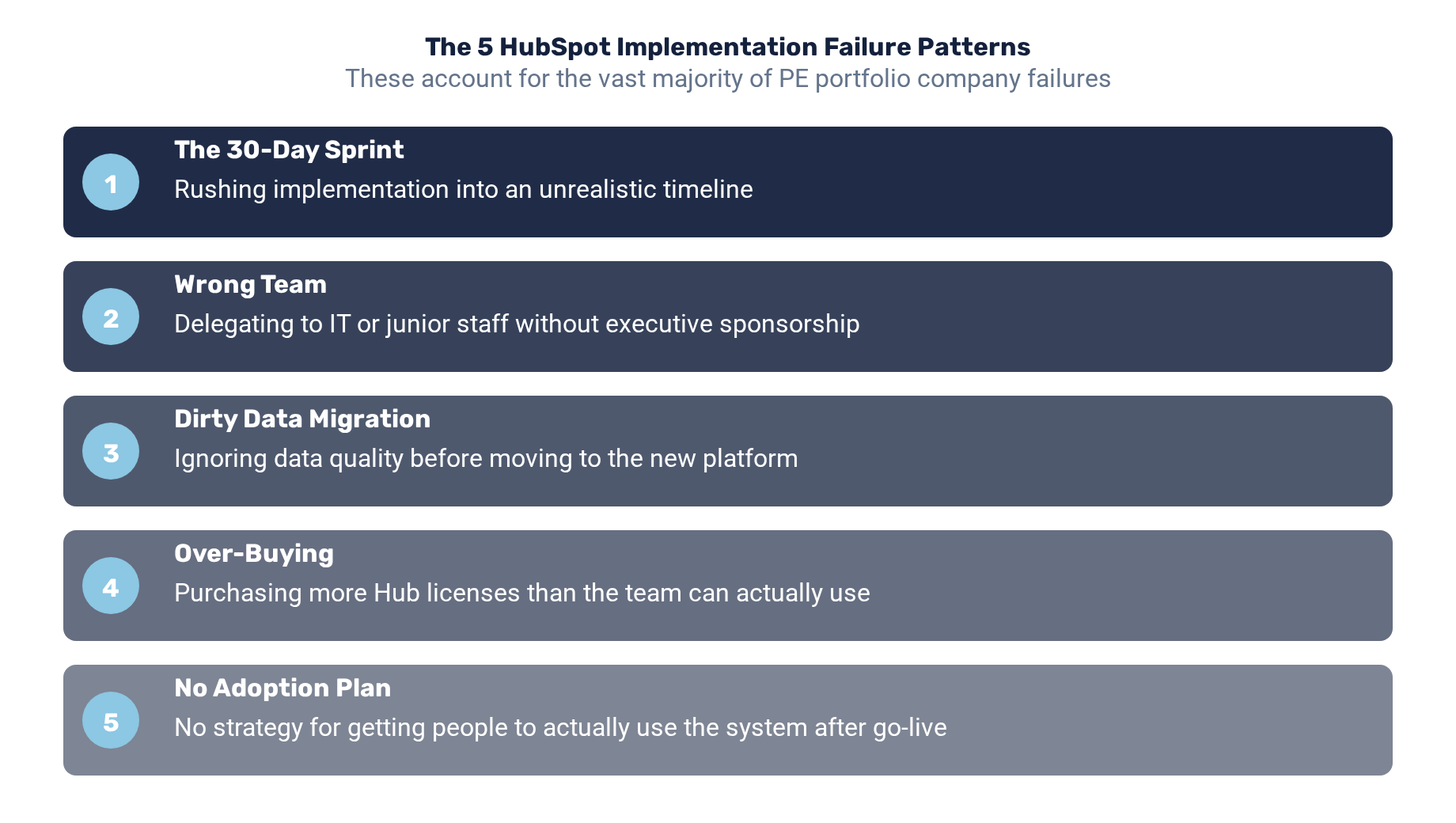
The Five Failure Patterns We See Repeatedly
After auditing dozens of failed or underperforming HubSpot implementations across PE portfolios, five patterns account for the vast majority of failures.
Pattern 1: The 30-Day Sprint Mentality
PE operating partners are conditioned to move fast. When a portfolio company needs a CRM, the instinct is to compress the timeline: buy the licenses in week one, configure in week two, train in week three, go live in week four.
This approach virtually guarantees failure. A proper HubSpot implementation for a company with 20-50 users requires 90-120 days minimum. That timeline includes discovery, data migration, integration configuration, custom property setup, workflow automation, and — critically — user training that goes beyond a single lunch-and-learn session.
Companies that rush implementation end up with a half-configured system that nobody trusts and nobody uses.
Pattern 2: Delegating to the Wrong Team
The second most common failure pattern is assigning the implementation to whoever is available rather than whoever is qualified. We routinely see implementations handed to:
- IT departments that understand infrastructure but not sales processes
- Marketing coordinators who know content but not pipeline management
- Junior operations analysts who lack the authority to enforce adoption
- The intern — yes, this actually happens
HubSpot implementation requires someone who understands both the technology and the business processes it needs to support. Without that dual expertise, you get a technically functional system that does not match how the business actually operates.
Pattern 3: Ignoring Data Quality Before Migration
Moving dirty data into a new CRM does not clean it — it contaminates the new system from day one. Yet most PE-backed implementations skip the data cleanup step entirely because it takes time and does not produce visible results.
The consequences are immediate. Duplicate records generate confusion. Missing fields break automation workflows. Inconsistent naming conventions make reporting unreliable. Within weeks of go-live, users lose trust in the data and revert to spreadsheets.
The rule is simple: clean before you migrate. Budget two to four weeks for data standardization, deduplication, and validation before any records move to HubSpot.
Pattern 4: Buying More Hub Than You Need
HubSpot's tiered pricing model creates a temptation to over-buy. PE firms, accustomed to enterprise software, often default to Enterprise tier across all Hubs — Marketing, Sales, Service, Operations — without a clear use case for the advanced features.
The result is a bloated license cost that immediately puts ROI pressure on the implementation, plus a feature set so complex that users are overwhelmed. We have seen companies paying $60,000+ annually for Enterprise Marketing Hub when their actual needs would be fully served by Professional at a third of the cost.
Right-size the investment. Start with the tier that matches your current maturity, and upgrade as your team's capabilities grow.
Pattern 5: No Adoption Plan Beyond Go-Live
The most dangerous assumption in any CRM implementation is that users will adopt the system because it exists. They will not. Without a deliberate adoption strategy, usage drops off within 60 days of go-live.
An effective adoption plan includes:
- Role-specific training — reps need to know how the CRM fits their daily workflow, not how every feature works
- Manager accountability — if management does not require CRM usage for forecasting and pipeline reviews, reps will not use it
- Quick wins — show users tangible time savings within the first two weeks
- Ongoing support — a dedicated resource for the first 90 days post-launch who can answer questions and fix issues in real time
The Organizational Dynamics That Drive Failure
Beyond these tactical patterns, there are organizational dynamics unique to PE-backed companies that amplify implementation risk.
Misaligned incentives. Portfolio company leadership teams are measured on revenue growth and EBITDA improvement. A CRM implementation does not directly move either metric in the short term, so it gets deprioritized whenever a revenue-generating initiative competes for attention.
Revolving leadership. PE-backed companies frequently experience leadership turnover. When the executive who championed the CRM implementation leaves, the initiative often loses momentum. The replacement may have different technology preferences or simply does not prioritize the project.
Holdco vs. portco tension. Operating partners at the holding company want standardization and visibility. Portfolio company leaders want autonomy and flexibility. This tension creates passive resistance — companies technically comply with the implementation mandate but do not invest the energy needed to make it successful.
How to Get It Right: The PE Implementation Framework
Reversing the 64% failure rate requires a fundamentally different approach.
Start with process, not technology. Before configuring a single property in HubSpot, document the company's actual sales process, lead management workflow, and reporting requirements. The technology should conform to the process, not the other way around.
Assign an implementation owner with authority. This person needs to be senior enough to enforce adoption and technical enough to make configuration decisions. If that person does not exist internally, engage an experienced HubSpot partner — not a generalist agency — who specializes in PE-backed implementations.
Build in phases. Rather than a big-bang go-live, implement in waves. Phase 1 covers core CRM functionality: contacts, companies, deals, and basic pipeline management. Phase 2 adds automation, email sequences, and reporting. Phase 3 introduces advanced features like custom reporting, lead scoring, and multi-touch attribution. Each phase includes its own training cycle and adoption checkpoint.
Set measurable success criteria. Define what success looks like before the implementation begins, and measure against those criteria at 30, 60, and 90 days post-launch. Examples include daily active users above 80%, pipeline data completeness above 90%, and forecast accuracy within 15% of actuals.
Budget for post-launch optimization. The implementation is not done at go-live. Budget three to six months of optimization support to refine workflows, adjust automation, and respond to user feedback. This is where most of the ROI actually materializes.
The ROI When You Get It Right
PE portfolio companies that implement HubSpot correctly see measurable returns within six months: 20-35% improvement in pipeline visibility, 15-25% faster sales cycle velocity, and a significant reduction in the manual reporting burden that consumes operating partner time. A healthcare SaaS company achieved measurable pipeline visibility within six months, enabling more confident revenue forecasting for board reporting.
More importantly, a well-implemented CRM creates the data infrastructure that supports every other value creation initiative — from marketing optimization to customer retention to M&A due diligence.
The 64% failure rate is not a reflection of HubSpot's capabilities. It is a reflection of how PE firms approach implementation. Fix the approach, and the platform delivers.
Keep Reading
- The Complete HubSpot Guide for PE — The framework that prevents these failure patterns.
- PE Implementation Roadmap — Structured roadmap with governance that avoids common failures.
- The True Cost of a Failed CRM Implementation — What these failures actually cost in dollars.
- Hidden Cost of Failed HubSpot Implementations — Warning signs and hidden costs to watch for.
- First 90 Days as a Revenue Operations Leader — Early intervention that prevents failure.
How healthy is your portfolio company's CRM? Take the free assessment — 7 minutes, instant results.