Your marketing team generates 500 leads this month. Your sales team receives them all in the same queue, with the same priority, and the same follow-up expectation. A VP of Operations at a $50M company who downloaded your pricing guide sits in the same list as a college student who clicked on a blog post.
This is how most organizations handle lead management, and it is costing them real money. When every lead receives equal treatment, your highest-value prospects get diluted attention while your sales team burns hours chasing contacts who will never buy.
The Real Cost of Lead Equality
Treating all leads equally is not a neutral decision — it actively damages your revenue engine in measurable ways.
Sales time misallocation. Research consistently shows that sales reps spend only about 35% of their time actually selling. When you add unqualified leads to their plate, that number drops further. A rep who spends 30 minutes researching and reaching out to a lead who was never going to buy is a rep who did not spend that 30 minutes on a prospect who could close this quarter.
Conversion rate dilution. When you measure lead-to-opportunity conversion rates across an undifferentiated pool, the numbers look terrible — typically 2-5%. This makes marketing look ineffective and sales look inefficient. But when you segment by lead quality, you discover that your best leads convert at 15-25% while your worst leads convert at less than 1%. The blended number hides the signal.
Rep burnout and cynicism. Nothing kills sales morale faster than a steady stream of low-quality leads. Reps learn to distrust marketing-generated leads, which leads to the exact sales-marketing misalignment that every organization claims to be working on. The root cause is not alignment workshops — it is lead quality.
Opportunity cost. Every minute spent on a Tier 3 lead is a minute not spent on a Tier 1 lead. Over the course of a quarter, this misallocation compounds into significant lost revenue.
The Tiered Lead Framework
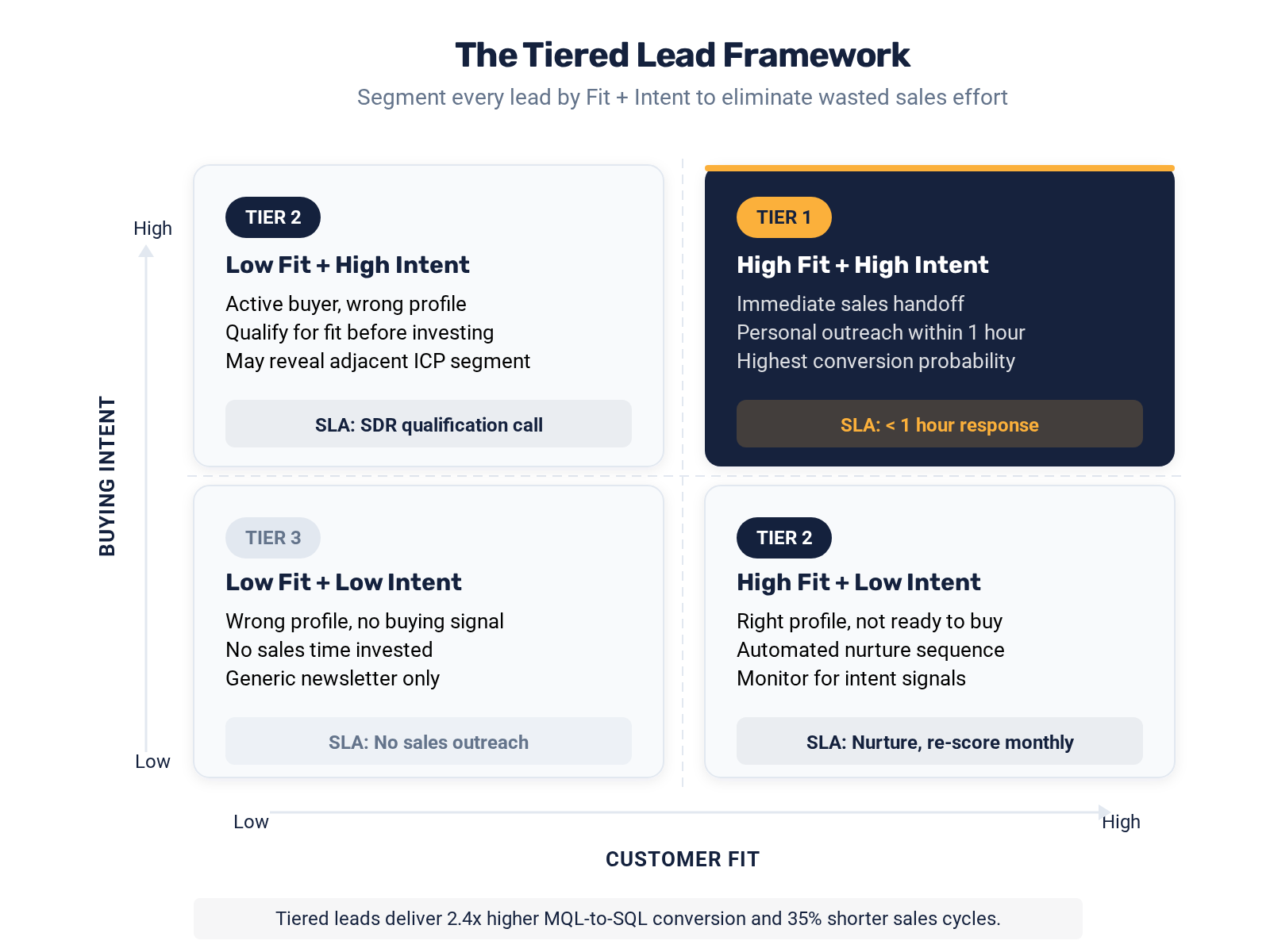
A tiered lead system assigns every incoming lead to a category based on fit and intent signals, then routes each tier through a different follow-up process optimized for its conversion probability.
Tier 1: High-Fit, High-Intent
These leads match your ideal customer profile and have demonstrated buying intent. They visited your pricing page, requested a demo, or downloaded a bottom-of-funnel asset. They have the right job title at the right size company in the right industry.
Treatment: Immediate human follow-up. A sales rep should be reaching out within five minutes. These leads get personalized outreach, a dedicated rep, and the fastest possible path to a conversation.
In HubSpot: Use lead scoring to identify these contacts automatically. Set up a workflow that assigns Tier 1 leads to a rep and creates a task with a five-minute deadline. Send an internal notification via Slack or email so the rep sees it instantly.
Tier 2: High-Fit, Low-Intent (or Low-Fit, High-Intent)
These leads have one of the two critical criteria but not both. Either they match your ICP but have not shown buying behavior, or they are showing intent signals but do not quite fit your target profile.
Treatment: Structured nurture with periodic human touchpoints. Enroll them in a targeted email sequence that educates and qualifies. A rep checks in at defined intervals — perhaps after they engage with specific content or their score increases.
In HubSpot: Create a nurture workflow that delivers value-driven content over 30-60 days. Set enrollment triggers based on lead score thresholds. When a Tier 2 lead's score crosses into Tier 1 territory, auto-promote them and notify the assigned rep.
Tier 3: Low-Fit, Low-Intent
These leads do not match your ICP and have not shown buying behavior. They might have downloaded a top-of-funnel resource or subscribed to your blog. They are real people, but they are not prospects.
Treatment: Fully automated nurture. No human sales touchpoint unless they self-select by taking a high-intent action. Marketing continues to educate them through content, but sales resources are not spent here.
In HubSpot: Enroll in a long-term drip campaign. Monitor for score changes that would promote them to Tier 2 or Tier 1. Otherwise, let automation handle the relationship.
Building Your Tier Criteria
The specific criteria for each tier depend on your business, but the framework for building them is universal.
Start with your closed-won data. Export your last 12-24 months of closed deals and analyze the contacts associated with them. What job titles appear most frequently? What company sizes? What industries? What content did they engage with before the deal closed? This data defines your fit and intent signals.
Define fit scoring. Assign point values to demographic and firmographic attributes. A VP title might be worth 20 points. A company with 100-500 employees might be worth 15 points. Being in your target industry is worth 10 points. Set the threshold that separates high-fit from low-fit.
Define intent scoring. Assign point values to behavioral actions. Visiting the pricing page is worth 30 points. Downloading a case study is worth 15 points. Opening three emails in a week is worth 10 points. Viewing a blog post is worth 2 points. Set the threshold that separates high-intent from low-intent.
Set tier boundaries. Tier 1 requires both fit and intent scores above their respective thresholds. Tier 2 requires one above threshold. Tier 3 has both below threshold.
Operationalizing Tiers in Your Tech Stack
A tiered system only works if it is automated and enforced. Manual tier assignment defeats the purpose.
Scoring automation. HubSpot's lead scoring tool handles the point calculations automatically based on property values and behavioral triggers. Configure it once, and every new lead is scored in real time. To automate tier assignments, build a pro-level lead score model in HubSpot that maps directly to your tier criteria.
Routing automation. Build workflows that read the tier assignment and execute the appropriate follow-up sequence. Tier 1 triggers immediate rep notification. Tier 2 enrolls in nurture. Tier 3 enters the drip campaign.
SLA enforcement. Set up HubSpot task queues with deadlines for each tier. Tier 1 gets a 5-minute SLA. Tier 2 gets a 24-hour SLA. Tier 3 has no human SLA. Build reports that track SLA compliance so management can identify reps who are not following the process.
Tier promotion tracking. Create a custom property that records tier changes over time. This data tells you how effective your nurture programs are at moving leads up the funnel.
Measuring the Impact
After implementing a tiered system, measure these metrics to quantify the improvement:
- Tier 1 conversion rate — this should be significantly higher than your old blended rate
- Average response time by tier — Tier 1 should be under 10 minutes
- Sales time allocation — reps should be spending more time on Tier 1 and 2 leads
- Nurture-to-Tier 1 promotion rate — how many Tier 2 and 3 leads are progressing
- Overall cost per opportunity — this should decrease as you stop wasting effort on low-probability leads
The Cultural Shift
Implementing lead tiers requires a cultural shift that goes beyond technology. Marketing needs to accept that not all leads are created equal and that generating fewer, higher-quality leads is more valuable than hitting a volume target. Sales needs to trust the scoring model enough to prioritize accordingly rather than cherry-picking based on gut feel.
The organizations that make this shift see dramatic improvements. We have worked with companies that doubled their Tier 1 conversion rates and reduced their cost per opportunity by 40% within 90 days of implementing a tiered system. The leads were always there — they just needed a system that treated them according to their actual potential.
PE portfolio companies that implement tiered lead management across their investments see dramatically better resource allocation — operating partners can benchmark conversion rates by tier across portcos and identify which companies are under-investing in their highest-value leads. The CRM standardization playbook includes lead scoring standardization as a core module.
Keep Reading
- Create a Pro-Level HubSpot Lead Score Model — Lead scoring builds on tiering foundation.
- Lead Scoring Pitfalls to Avoid — Tiering prevents common scoring pitfalls.
- Why Your Sales Team Is Ignoring Marketing Leads — Sales ignores leads due to lack of tiering.
How healthy is your portfolio company's CRM? Take the free assessment — 7 minutes, instant results.