Every marketing team claims to be data-driven. Very few actually are. Most teams have dashboards, run reports, and cite metrics in their presentations. But having data and being driven by it are fundamentally different things. The gap between the two — what we call the Data Truth Gap — is where most marketing organizations lose their way.
What Data-Driven Actually Means
Being data-driven means that data shapes strategy, not just validates it. It means you change direction when the data contradicts your assumptions. It means you invest in data infrastructure with the same seriousness you invest in campaigns. And it means every decision — from channel allocation to content strategy to headcount — is rooted in evidence rather than intuition.
Most marketing teams fall short of this standard in predictable ways.
They optimize locally but not globally. A team might A/B test email subject lines (local optimization) while allocating their entire channel budget based on what they spent last year (no optimization at all). They optimize the tactics while ignoring the strategy.
They track outputs, not outcomes. Dashboards full of impressions, clicks, opens, and page views feel data-driven. But these vanity metrics do not connect to business outcomes — revenue, pipeline, customer acquisition cost, lifetime value. A team can show 50% email open rate growth while pipeline contribution declines.
They use data to confirm, not to challenge. Confirmation bias is rampant in marketing. Teams pull the data that supports their preferred narrative and ignore the data that contradicts it. The campaign report highlights the one metric that improved while burying the three that declined.
They lack a single source of truth. Marketing data lives in multiple platforms — HubSpot, Google Analytics, social media tools, ad platforms, spreadsheets — each showing slightly different numbers. When the same metric yields different answers depending on where you look, trust erodes and data becomes a tool for argument rather than alignment.
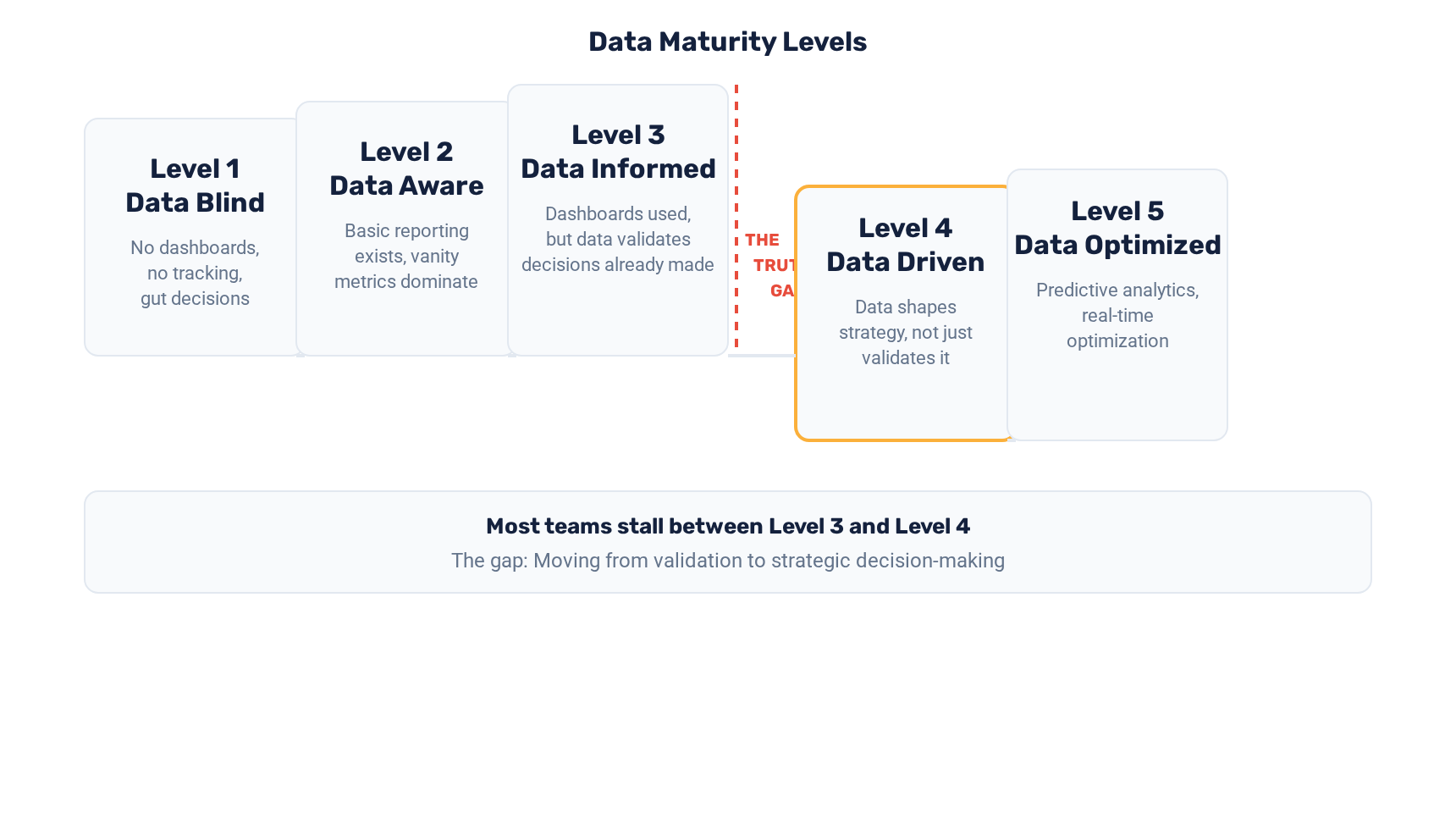
The Five Levels of Data Maturity
Understanding where your team falls on the data maturity spectrum helps you focus improvement efforts where they will have the most impact.
Level 1: Data Blind
No consistent tracking. Decisions are based on intuition, anecdote, and the loudest voice in the room. There are no dashboards, no regular reporting, and no metrics-based accountability.
Level 2: Data Aware
Basic tracking is in place — website analytics, email metrics, social media stats. Reports are generated but not consistently reviewed or acted upon. Data exists but does not influence decisions.
Level 3: Data Informed
Regular reporting cadences are established. Teams review performance monthly and make tactical adjustments based on what the data shows. However, the data is siloed by channel, attribution is incomplete, and strategic decisions are still largely intuition-driven.
Level 4: Data Driven
An integrated data infrastructure connects marketing activity to revenue outcomes. Attribution is multi-touch. Channel allocation is based on ROI analysis. Decisions that contradict the data require explicit justification. Data quality is actively managed.
Level 5: Data Optimized
Predictive analytics and machine learning augment human decision-making. Marketing mix modeling optimizes budget allocation across channels. Customer lifetime value predictions inform acquisition strategy. The team continuously tests assumptions and updates models based on new data.
Most marketing teams operate at Level 2 or 3. They have the tools and the data but lack the infrastructure, processes, and culture to move to Level 4.
Why Teams Get Stuck at Level 3
The jump from Data Informed (Level 3) to Data Driven (Level 4) is the hardest one, and it is where most teams stall. Three obstacles consistently block the transition.
Obstacle 1: Fragmented Data Infrastructure
When your data lives in seven different platforms with no integration layer, you cannot build the unified view needed for true data-driven decision-making. Each platform is a data island — accurate within its own context but disconnected from the broader picture.
The fix: Centralize your marketing data in a single platform. HubSpot's Marketing Hub, when properly configured with integrations, can serve as this single source of truth. Connect Google Ads, LinkedIn, social platforms, and web analytics into HubSpot so that every marketing touchpoint feeds into the same contact record. When channel data, engagement data, and revenue data share the same database, cross-channel analysis becomes possible. For a staged approach to solving this, see how to move from marketing data chaos to clarity.
Obstacle 2: No Revenue Attribution
Tracking clicks and conversions is not enough. You need to trace the full path from first marketing touch to closed revenue. Without attribution, you cannot answer the fundamental question every CMO faces: "Which marketing investments are generating the most revenue?"
The fix: Implement multi-touch attribution reporting in HubSpot. Configure attribution models — first touch, last touch, linear, U-shaped, W-shaped — and analyze revenue attribution from multiple perspectives. No single model tells the full truth, but using multiple models together gives you a nuanced understanding of how marketing influences the buyer's journey.
Obstacle 3: No Data Governance
Data quality degrades naturally. Contacts change jobs, email addresses bounce, and manual data entry introduces inconsistencies. Without governance — standardized naming conventions, required fields, automated cleanup workflows, and regular audits — your data becomes progressively less trustworthy.
The fix: Establish data governance practices that prevent degradation. Standardize UTM parameters. Require consistent naming conventions for campaigns. Build automation workflows that clean and standardize data at the point of entry. Conduct quarterly data quality audits and measure completeness, accuracy, and consistency.
Closing the Data Truth Gap
Moving from Data Informed to Data Driven requires investment in three areas.
Infrastructure investment. Budget for the integrations, tools, and configuration needed to create a unified data layer. This is not a one-time project — it is an ongoing commitment to maintaining the infrastructure.
Process investment. Establish regular cadences for data review, optimization, and governance. Monthly marketing analytics reviews that connect activity to revenue outcomes. Quarterly attribution reviews that assess channel effectiveness. Annual data quality audits that maintain the integrity of the foundation.
Cultural investment. Build a team culture that values evidence over intuition. Reward people who surface uncomfortable truths in the data. Celebrate decisions that changed based on new evidence. Make it safe to say "the data shows our assumption was wrong."
The Data Truth Gap is not a technology problem. It is a maturity problem. Closing it requires discipline, investment, and a genuine willingness to let data drive decisions — even when those decisions are uncomfortable. The marketing teams that cross this threshold outperform their peers dramatically, because they are optimizing against reality while their competitors optimize against assumptions.
This data trust gap is magnified in PE portfolio environments where operating partners depend on accurate cross-company reporting to make investment decisions. Our due diligence checklist specifically evaluates data quality as a leading indicator of operational maturity.
Keep Reading
- The True Cost of Bad Data — Bad data is the root cause of the truth gap.
- Psychology of Data Governance — Why teams resist the governance that fixes this.
- Marketing Operations & RevOps Services — We address data quality and governance gaps.
How healthy is your portfolio company's CRM? Take the free assessment — 7 minutes, instant results.